



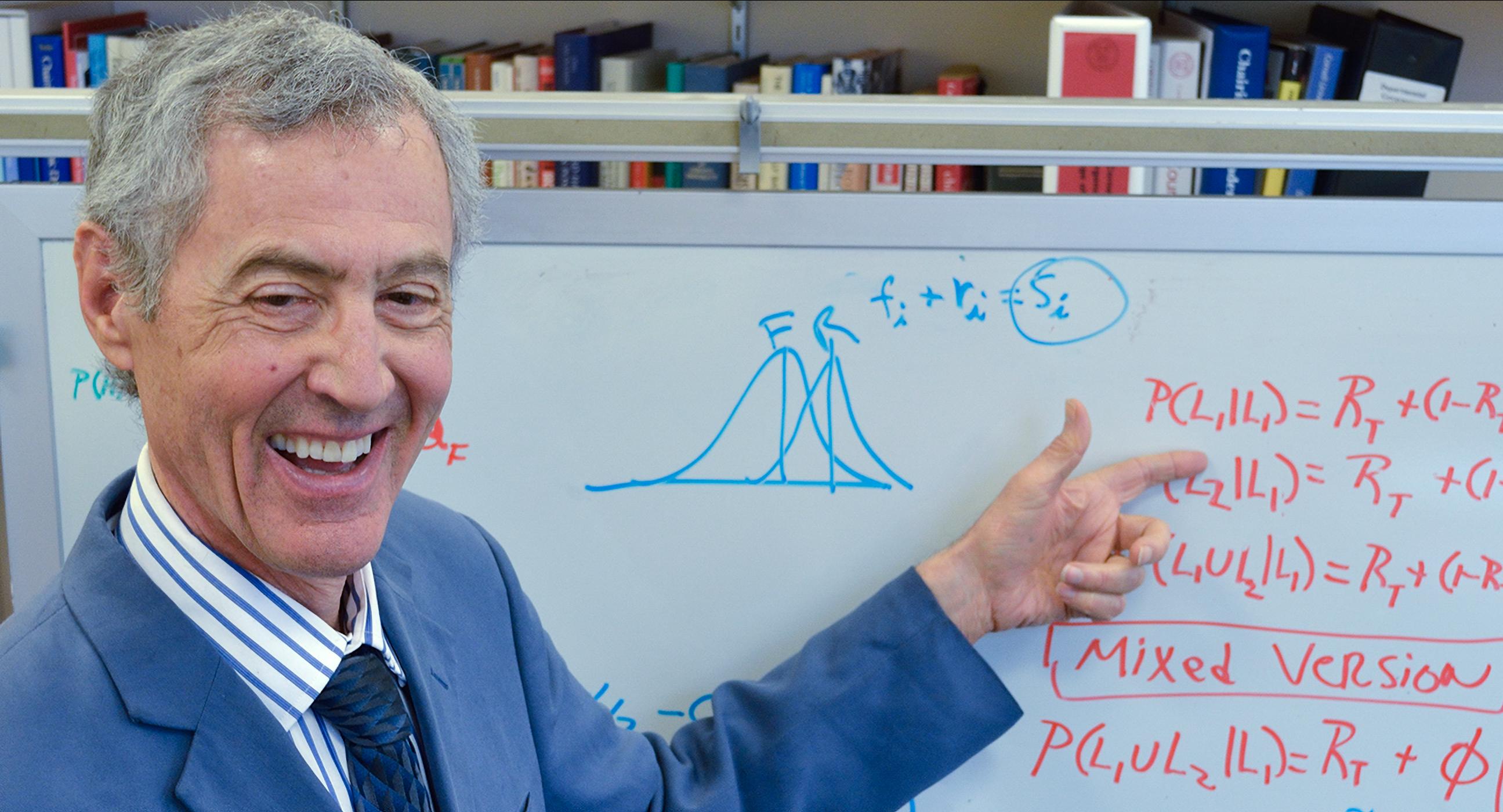
Use General Processing Tree (GPT) (Hu & Phillips, 1999)
- GPT is a Windows based computer program used for analyzing multinomial processing tree models. The program allows conducting various modeling tasks, including parameter estimation, hypothesis testing, and power analysis. For a description of the program, see Hu and Phillips (1999). The program is available at http://www.xiangenhu.info upon request and MPT Models Workshop
- Model Files in GPT: CR model.zip
Use MPT in R package
- R program is an alternative program to the GPT (Download R: http://cran.r-project.org)
- MPTinR is a R package for analyzing multinomial processing with R: More information about MPT in R package.
- Conjoin recognition (CR) model in R tutorial
- Model Files in R: Model Files: (This folder contains multiple EQN files, including CR model, CR model -reduced sentences and CR model - all sentences).
References
- Brainerd, C. J., Nakamura, K., & Lee, W.-F. A. (2019). Recollection is fast and slow. Journal of Experimental Psychology: Learning, Memory, and Cognition, 45(2), 302–319. doi: 10.1037/xlm0000588
- Brainerd, C. J., Wright, R., Reyna, V. F., & Mojardin, A. H. (2001). Conjoint recognition and phantom recollection. Journal of Experimental Psychology: Learning, Memory, and Cognition, 27(2), 207-327.
Use General Processing Tree (GPT)
- Dual-retrieval model tutorial.pdf:The purpose of this tutorial is to outline the application of a group of two-stage Markov models that have been used to quantify recollective and nonrecollective retrieval processes (Brainerd, Aydin, & Reyna, 2012; Brainerd & Reyna, 2010; Brainerd, Reyna, & Howe, 2009; Gomes, Brainerd, & Stein, 2013). The tutorial provides a step-by-step guide on how to compute the relevant statistics to obtain parameter estimates and goodness-of-fit statistics. Because the models measure retrieval operations that can be broadly separated into recollective (direct access, D) and nonrecollective ones (reconstruction, R, and familiarity judgment, J), we also refer to them as dual-retrieval models. For specific information about the models and the theory underlying them, please see Brainerd et al. (2009).
- Example files used in DR model GPT tutorial
- Microsoft Excel: Used to compute the frequencies of correct recall (C) and incorrect recall (E) across trials using a simple Visual Basic (VB) macro. Click here to download the VB Macro file.
- Model files in GPT:
11 parameters - 4 fixed trials.zip
Error model - 6p - 3 fixed trials.zip
Alternative 3Js Error model - 6 parameters - 3 fixed trials.zip
Success model - 6p - 3 fixed trials.zip
Both model - 6p - 3 fixed trials.zip - OPTIONAL file: Data entry using GPT can be time consuming when the total number of experimental conditions is large or, in the case of individual data analysis, the sample size is large. Below is a VB macro that creates a GPT model file containing the frequencies of C-E patterns stored on a .TXT or .CSV file (only available for the reduced dual-retrieval models). The file contains a data file example (.txt and .csv) and the GPT model structure file of each reduced dual-retrieval model (the program uses them to generate a new GPT model file containing the entries in the data file). Transfer data to GPT.zip
Use MPT in R package
- Dual-retrieval model in R Tutorial
- MPT in R package Model Files: .EQN files, includes 11 parameters - 4 fixed trials, Error model - 6 parameters - 3 fixed trials, Alternative 3Js Error model - 6 parameters - 3 fixed trials, Both model - 6 parameters - 3 fixed trials.
Example data files
- semantic ambiguity concreteness exp.xlsx
- semantic ambiguity categorization exp.xlsx
- semantic ambiguity meaningfulness exp.xlsx
References
- Gomes, C. F. A., Brainerd, C. J., Nakamura, K., & Reyna, V. F. (2014). Markovian interpretations of dual retrieval processes. Journal of mathematical psychology, 59, 50-64. doi: 10.1016/j.jmp.2013.07.003
- Brainerd, C. J., Reyna, V. F., Gomes, C. F. A., Kenney, A. E., Gross, C. J., Taub, E. S., . . . the Alzheimer’s Disease Neuroimaging Initiative. (2014). Dual-retrieval models and neurocognitive impairment. Journal of Experimental Psychology: Learning, Memory, and Cognition, 40, 41– 65. doi: 10.1037/a0034057
- Brainerd, C. J., Wright, R., Reyna, V. F., & Payne, D. G. (2002). Dual-retrieval processes in free and associative recall. Journal of Memory and Language, 46(1), 120-152.
Model files for the source conjoint recognition procedure: The multinomial, mixed, and signal detection versions of the dual-recollection model can be found below. EQN files are compatible with most multinomial processing tree programs, but only the multinomial version of the model is available in such format. The Excel file, on the other hand, contains all three versions of the dual-recollection model (one in each tab) that can be used to analyze the data from related and unrelated distractors in the conjoint recognition paradigm. To use the Excel file, it is necessary to enable VB macros and activate the Solver add-in.
- Dual-recollection EQN model files. This is a modification of Jacoby’s (1991) process-dissociation model. The folder includes two model files: 1) Dual-recollection multinomial model - RD, UD; 2) Dual-recollection multinomial model - TG, RD, UD).
- Dual-recollection multinomial EQN model files. This is compatible with source-monitoring paradigm.
- Dual-recollection model in Microsoft Excel. This folder includes two Excel files: 1) Multinomial, mixed, and signal detection models - RD, UD - CR procedure; 2) Multinomial, mixed, and signal detection models - TG, RD, UD.
- Model files for the conjoint process dissociation procedure that are compatible with MPT in R package: MPT in R model files. Dual-recollection mixed multinomial and signal detection model - Conjoint PDP.model. Dual-recollection signal detection model - Conjoint PDP.model.
References
- Brainerd, C. J., Gomes, C. F. A., & Moran, R. (2014). The two recollections. Psychological Review, 121, 563–599. doi: 10.1037/ a0037668
- Brainerd, C. J., Reyna, V. F., Holliday, R. E., & Nakamura, K. (2012). Overdistribution in source memory. Journal of Experimental Psychology: Learning, Memory, and Cognition, 38, 413– 439. doi:10.1037/a0025645
Gomes, C. F. A., Brainerd, C. J., & Stein, L. M. (2013). Effects of emotional valence and arousal on recollective and nonrecollective recall. Journal of Experimental Psychology: Learning, Memory, and Cognition, 39, 663-677. doi:10.1037/a0028578
Brainerd, C. J., Aydin, C., & Reyna, V. F. (2012). Development of dual-retrieval processes in recall: Learning, forgetting, and reminiscence. Journal of Memory and Language, 66, 763-788. doi: 10.1016/j.jml.2011.12.002
Brainerd, C. J., & Reyna, V. F. (2010). Recollective and nonrecollective recall. Journal of Memory and Language, 63, 425-445. doi:10.1016/j.jml.2010.05.002
Brainerd, C. J., Reyna, V. F., & Howe, M. L. (2009). Trichotomous processes in early memory development, aging, and cognitive impairment: A unified theory. Psychological Review, 116, 783-832. doi:10.1037/a0016963
Hu, X., & Phillips, G. A. (1999). GPT.EXE: A powerful tool for the visualization and analysis of general processing tree models. Behavior Research Methods, Instruments, & Computers, 31, 220-234. doi:10.3758/BF03207714