



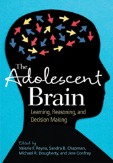
Teenage brains undergo big changes, and they won't look or function like adult brains until well into one's 20s. In the first book on the adolescent brain and development of higher cognition, Valerie Reyna helps highlight recent neuroscience discoveries about how the brain develops and their implications for real-world problems and how we teach young people and prepare them to make healthy life choices.
For "The Adolescent Brain: Learning, Reasoning, and Decision Making" (APA Books), Reyna brought together an interdisciplinary group of leading scientists to focus on brain development and higher cognition, which is necessary for students to learn math and science and make good decisions. Higher cognition is the set of thinking skills students use to manipulate information and ideas in ways that lead to problem solving and new insights.
"A major implication of the provocative research highlighted in this book is the contrast between adolescents' cognitive skills, which are at a lifetime peak, and their frequent inability to use this competence in everyday decision making," said Reyna, who co-edited the volume with Sandra Chapman, director of the Center for Brain Health at the University of Texas at Dallas; Michael Dougherty, professor of psychology at University of Maryland; and Jere Confrey, professor of mathematics education at North Carolina State University.
"But the evidence suggests that the way young people learn, reason and decide changes[during this period] and can be changed," said Reyna. "We must move education beyond rote learning to fostering the cognitive skills essential for academic achievement and economic well-being in our knowledge-based economy. Higher cognition is a foundation critical for individuals and our country to be competitive. This volume introduces a new framework for interdisciplinary collaboration among scientists in neuroscience, psychology and education."
"The Adolescent Brain" addresses the major changes in memory, learning and decision making experienced by adolescents as they mature, beginning with a review of the changes in brain anatomy and physiology based on extensive neuroimaging studies. The ensuing chapters examine the developing capacity of the adolescent brain, covering such topics as the underpinnings of intelligence and problem solving, strategies for training teen reasoning abilities, effectively teaching mathematical concepts, the effects of emotion on reasoning, and factors that promote teen engagement in health-related behaviors.
The book wraps up with a chapter by Reyna and Ph.D. student Christina Chick that integrates the behavioral and neuroscience evidence in a process model of adolescent risky decision making. Chick and Reyna explain, for example, how massive pruning of gray matter in late adolescence fits with the growth of adolescents' ability to connect the dots and understand the underlying meaning of situations. This gist thinking facilitates recognition of danger and protects against unhealthy risk-taking, they say.
The book is intended for researchers, students and professionals in the fields of cognitive neuroscience and psychology and for education policymakers and educators, especially in mathematics.
Reyna presented a talk on the "Adolescent Brain" March 1, 2012 at 4-5:30 p.m., 160 Mann Library on the Cornell Ithaca campus.
***See it on Reyna's Publications page
The presentations below were recorded from the Workshop on Higher Cognition in Adolescents and Young Adults and form the basis for many of the book chapters in The Adolescent Brain. Related papers by the authors are also available to conference participants (and others by request).
Mark Ashcraft - Upgrading to Math Cognition 2.0: Where We Need to Go
Roberto Cabeza - Neural Correlates of Recollection and Familiarity
Sandra Chapman - Strategic Memory and Reasoning in Teens
Jere Confrey - Learning Trajectories and Rational Number Reasoning
Nancy Dennis - The Neural Correlates of True and False Memory Retrieval
Michael Dougherty - Diagnosing Diagnostic Hypothesis Generation in Adolescents
Adriana Galvan - Risky Behavior in Adolescents: The Role of the Developing Brain
Keith Holyoak - Analogy, Comparative Intelligence, and Brain
Ken Koedinger - Interactive Support for Mathematical Reasoning and Metacognitive Judgments of Learning
David Laibson - Neuroeconomics: The Multiple Systems Hypothesis
Ken McRae - Studying Objects Concepts by Combining Feature Norms, Connectionist Networks, and Modality-specific Representations
Sandra Schneider - Context, Experience and Feelings: Proximal Drivers of Adolescent Reasoning and Decision Making
Dan Schwartz - Why Direct Instruction Earns a C- in Transfer
Vladimir Sloutsky - The Cost of Concreteness in Transfer of Mathematical Knowledge
Keith Stanovich - What Intelligence Tests Miss: Individual Differences in Reasoning Beyond IQ
Mark Steyvers - Extracting Semantic Themes with Topic Models
Patrick Thompson - Foundational Meanings in Support of Advanced Mathematical Thinking Among Adolescents
The Adolescent Brain: Learning, Reasoning and Decision Making
Preface - Valerie F. Reyna
Introduction - Valerie F. Reyna, Sandra B. Chapman, Michael R. Dougherty, and Jere Confrey
I. Foundations
1. Anatomic Magnetic Resonance Imaging of the Developing Child and Adolescent Brain - Jay N. Giedd, Michael Stockman, Catherine Weddle, Maria Liverpool, Gregory L. Wallace, Nancy R. Lee, Francois Lalonde, and Rhoshel K. Lenroot
II. Memory, Meaning, and Representation
2. Semantic and Associative Relations in Adolescents and Young Adults: Examining a Tenuous Dichotomy - Ken McRae, Saman Khalkhali, and Mary Hare
3. Representation and Transfer of Abstract Mathematical Concepts in Adolescence and Young Adulthood - Jennifer A. Kaminski and Vladimir M. Sloutsky
4. A Value of Concrete Learning Materials in Adolescence - Kristen P. Blair and Daniel L. Schwartz
5. Higher-Order Strategic Gist-Reasoning in Adolescence - Sandra B. Chapman, Jacquelyn F. Gamino, and Raksha Anand
III. Learning, Reasoning, and Problem Solving
6. Better Measurement of Higher-Cognitive Processes through Learning Trajectories and Diagnostic Assessments in Mathematics: The Challenge in Adolescence - Jere Confrey
7. Adolescent Reasoning in Mathematical and Non-Mathematical Domains: Exploring the Paradox - Eric Knuth, Charles Kalish, Amy Ellis, Caroline Williams, and Mathew Felton
8. Training the Adolescent Brain: Neural Plasticity and the Acquisition of Cognitive Abilities - Sharona M. Atkins, Michael F. Bunting, Donald J. Bolger, and Michael R. Dougherty
9. Higher Cognition is Altered by Non-Cognitive Factors: How Affect Enhances and Disrupts Mathematics Performance in Adolescence and Young Adulthood - Mark H. Ashcraft and Nathan O. Rudig
IV. Judgment and Decision Making
10. Risky Behavior in Adolescents: The Role of the Developing Brain - Adriana Galvan
11. Affective Motivators and Experience in Adolescents’ Development of Health-Related Behavior Patterns - Sandra L. Schneider and Christine M. Caffray
12. Judgment and Decision Making in Adolescence: Separating Intelligence from Rationality - Keith Stanovich, Richard F. West, and Maggie E. Toplak
13. A Fuzzy-Trace Theory of Adolescent Risk Taking: Beyond Self-Control and Sensation Seeking - Christina Chick and Valerie F. Reyna
V. Epilogue
14. Paradoxes in the Adolescent Brain in Cognition, Emotion, and Rationality - Valerie F. Reyna