


Courses you could take

Learn how leaders in a variety of fields use design as a social change agent, connecting theories of leadership and creative problem-solving through case studies.

Examine how human attitudes and behaviors affect environmental quality, with examinations of environmental justice and culture.

Explore the use of design methods to generate ideas and evaluate designed objects, environments and interfaces using hands-on activities provide opportunities for application.


Many DEA students seek real-world experience in the kinds of work they hope to pursue after graduation through summer internships, both paid and unpaid. These may be with design and architecture firms, major corporations, or specialty consulting firms.
DEA cannot guarantee any student an internship, but, in conjunction with the Career Development Office, students are provided assistance with internship searches and in developing resumes and preparing for interviews.
Internship examples
- Design Intern, Stantec Interior
- Design Strategy Intern, Perkins and Will, HDR
- Research Intern, Laidlaw Research and Leadership Program
- Research Intern, Regenerative Andean Agroforestry Landscape
- User Experience Design Intern, ChaseDesign, Honeywell, Tesla
- Workplace Design Intern, Gensler
Also, see all Cornell Human Ecology off-campus learning options.

- Brand identity and positioning
- Creative design process and methods
- Design with digital media
- Human-centered design
- Interactive and adaptable environments
- Strategic business planning
- User experience design
- Workplace strategy

- Assistive technologies
- Design across the life-course
- Design for human potential
- Environmental justice
- Human health and wellness
- Healing and healthcare design
- Inclusive design
- Understanding environmental stressors

- Green ergonomics
- Life-cycle evaluation and LEED
- Regenerative and resilient design
- Sustainable building
- Sustainable materials and processes
- Triple bottom line: E3


Director of Undergraduate Studies, Design + Environmental Analysis


Professor


In order to graduate with Honors students must be in residence for eight semesters (students can still opt for study abroad programs, etc., because these programs require registration as a Cornell student). Transfer students are eligible for the Honors Program as long as they remain in residence for all semesters after they transfer. Students must achieve a GPA of at least 3.3 to be eligible for the Honors Program, and the 3.3 GPA minimum must be maintained after being admitted into the Honors Program. Students whose GPA drops below 3.3 will be dropped from the Honors Program (these students can register for special studies in order to complete their research).
Students should apply for acceptance into the DEA Honors Program during the first semester of their junior year. DEA students who intend to apply for the honors program should contact the undergraduate program coordinator at dea-dus [at] cornell.edu.
The following is a description of the faculty and staff associated with the honors thesis:
- Committee chair — This person must be a faculty member (professorial rank) in DEA who works with the student on a commonly agreed topic of study for their thesis.
- External examiner (also referred to as reader) — This person must be an outside faculty member with whom student will work with during their honors thesis. The external examiner should be a faculty from a non DEA department. A DEA faculty member with expertise in a different concentration may be accepted if recommended by the chair. The student will work with their committee chair to select an external examiner.
- DEA "at-large" honors representative — This person is a pre-selected DEA faculty member whose role is to provide comparability of standards across student theses at the department. The current "at-large" honors representative for DEA is Prof. So-Yeon Yoon.
- Academic programs coordinator — This person is a designated staff member in the department who provides academic support to students. The academic programs coordinator for DEA isdjg326 [at] cornell.edu ( Darin Gillenwater).
The major component of the Honors Program is the honors thesis. The student's original research must be written up in a formal scientific manner, or a manner appropriate to the major, following the advice of the DEA faculty committee chair. If the topic requires approval by the University Committee on Human Subjects, this must be obtained prior to commencing the research.
DEA 4990 Senior Honors Thesis is the official course title for the Honors Program research. Students must register (for six credits) in DEA 4990 Senior Honors Thesis starting in the fall (or first) semester of their senior year, by adding the course officially through the Registrar's Office. (See timeline for details.)
Research will be supervised by the honors thesis committee members. The student will write their thesis under the direct supervision of the committee chair. The actual submission date and defense will be agreed by the committee chair and the external examiner and planned ahead by the student in collaboration with the committee chair and the external examiner. The committee chair and the external examiner must receive the thesis at least one week prior to the defense, and either committee member may request revisions, which must be incorporated into the final version of the written thesis that is due by the last day of classes. The final research will be graded based on the thesis and the oral thesis defense given by the student to their committee chair and the external examiner.
August-September of your junior year
- Submit your DEA Honors Program application.
August-September of your senior year
- You and your HCD faculty committee chair will need to develop the specifics of your research and determine whether or not your studies/thesis will require approval by the University Committee on Human Subjects. If so, you will need to pass the University Human Subjects Committee training before any submission is made. Note that the approval process can take from two to six weeks depending on the nature of the research, so plan your timeline accordingly. The process can take longer if revisions and resubmission is required. It is recommended that you seek Human Subjects approval for your thesis during the spring semester of your junior year, as approvals last for 12 months.
- You will need to meet with your committee chair to determine how many credits you will register for when signing up for DEA 4990. It is usually 3 credits per semester for the maximum of 6 credits in total (3 per semester). Enrollment occurs during the first three weeks of each semester.
- You must make sure you are enrolled in DEA 4990 (enrollment is done using an add/drop slip).
- You and your committee chair can add other special members to the committee as appropriate.
- You and your committee chair should agree on a schedule for the thesis research to ensure that everything is completed on time.
January-March of your senior year
- January-February: You and your committee chair should invite an external examiner (also referred as reader) to examine the thesis research and ensure the willingness and availability of this person for the oral defense. This person must be an outside faculty member with whom the student will work during their honors thesis. The external examiner should be a faculty from a non-HCD department. An HCD faculty member with expertise in a different concentration may be accepted if recommended by the committee chair.
- By March 15 (or a date agreed by your committee chair and external examiner): Submit a full draft to your committee chair and external examiner.
April-May of your senior year
- April 1-14: Schedule your honors thesis defense. This must be agreed by your committee chair and external examiner.
- April 15-May 4: Time period for a date for the defense of your honors thesis. The committee chair and external examiner must be at the defense. Others can also be invited. The defense will consist of an oral presentation of the thesis research, typically 15-30 minutes, followed by questions and answers. The committee chair and external examiner will discuss your performance and the research thesis in private. You then will be informed of the evaluation of your oral defense and any necessary revisions required to your thesis to constitute successful completion of your honors program.
- After the thesis defense: Complete any required revisions to your thesis and send a digital final copy (pdf) to the DEA academic programs coordinator, your committee chair and external examiner. The DEA academic programs coordinator will either upload the final copy (if you choose) to eCommons, Cornell’s Digital Repository or will submit a hard copy to the University Archives. Please note that you will need to sign a FERPA release form for digital or hard copy and fill out a proxy form, so that the DEA academic programs coordinator can submit to eCommons on your behalf.
- Once the honors defense and thesis has been satisfactorily completed, the DEA “at-large” honors representative and the DEA academic programs coordinator must be notified by your committee chair.
- Honors students are encouraged to present a poster describing their research at a time and place to be announced by the college.
The DEA academic programs coordinator will submit the names of successful honors students to the College Registrar’s Office no later than May 15 of the student’s senior year.
Beginning of your junior year
- Submit your DEA Honors Program application.
Beginning of your senior year
- You and your HCD faculty committee chair will need to develop the specifics of your research and determine whether or not your studies/thesis will require approval by the University Committee on Human Subjects. If so, you will need to pass the University Human Subjects Committee training before any submission is made. Note that the approval process can take from two to six weeks depending on the nature of the research, so plan your timeline accordingly. The process can take longer if revisions and resubmission is required. It is recommended that you seek Human Subjects approval for your thesis during the spring semester of your junior year, as approvals last for 12 months.
- You will need to meet with your committee chair to determine how many credits you will register for when signing up for DEA 4990. It is usually 3 credits per semester for the maximum of 6 credits in total (3 per semester). Enrollment occurs during the first three weeks of each semester.
- You must make sure you are enrolled in DEA 4990 (enrollment is done using an add/drop slip).
- You and your committee chair can add other special members to the committee as appropriate.
- You and your committee chair should agree on a schedule for the thesis research to ensure that everything is completed on time.
August-October of your senior year
- August-September: You and your committee chair should invite an external examiner (also referred as reader) to examine the thesis research and ensure the willingness and availability of this person for the oral defense. This person must be an outside faculty member with whom the student will work during their honors thesis. The external examiner should be a faculty from a non-HCD department. An HCD faculty member with expertise in different concentration may be accepted if recommended by the committee chair.
- By October 15 (or a date agreed by your committee chair and external examiner): Submit a full draft to your committee chair and external examiner.
November-December of your senior year
- November 1-14: Schedule your honors thesis defense. This must be agreed by your committee chair and external examiner.
- November 15-December 3: Time period for a date for the defense of your honors thesis. The committee chair and external examiner must be at the defense. Others can also be invited. The defense will consist of an oral presentation of the thesis research, typically 15-30 minutes, followed by questions and answers. The committee chair and external examiner will discuss your performance and the research thesis in private. You then will be informed of the evaluation of your oral defense and any necessary revisions required to your thesis to constitute successful completion of your honors program.
- After the thesis defense: Complete any required revisions to your thesis and send a digital final copy (pdf) to the DEA academic programs coordinator, your committee chair and external examiner. The DEA academic programs coordinator will either upload the final copy (if you choose) to eCommons, Cornell’s Digital Repository or will submit a hard copy to the University Archives. Please note that you will need to sign a FERPA release form for digital or hard copy and fill out a proxy form, so that the DEA academic programs coordinator can submit to eCommons on your behalf.
- Once the honors defense and thesis has been satisfactorily completed, the DEA “at-large” honors representative and the DEA academic programs coordinator must be notified by your committee chair.
- Honors students are encouraged to present a poster describing their research at a time and place to be announced by the college.
- The DEA academic programs coordinator will submit the names of successful honors students to the College Registrar’s Office no later than December 7 of the student’s senior year.
If you have additional questions, please contact So-Yeon Yoon, DEA's "at-large" Honors Program representative.





DEA’s curriculum allows students the opportunity to participate in a study abroad program off-campus while still earning academic credit. To adequately plan for one semester away, students should visit the college’s Career Exploration Center and meet with their DEA academic advisor at the start of their sophomore year. Off-campus experiences should be completed during the student’s junior year at Cornell, preferably the spring of that year.
Courses taken off-campus serve predominately as electives in a student’s academic program. A few courses may be applied to university or college requirements, such as humanities and language. Credits completed through Study Abroad will serve as electives only and may not be accepted as substitutions toward DEA requirements . Academic credits taken through the following programs: Exchange Programs, Capital Semester, Urban Semester, and Cornell in Washington, may be petitioned as substitutions for DEA thematic requirements if they are deemed to be similar in content and contact hours to DEA courses. Off-campus course substitutions are limited to seven credit hours toward DEA thematic requirements, including up to one thematic studio.
It is the students’ responsibility to provide adequate evidence comparing the off- campus course with its counterpart in DEA. Evidence may include syllabi from both courses, examples of student work produced in the off-campus course, etc. A short catalog course description alone is not sufficient evidence to evaluate substitution petitions. Students are encouraged to discuss their course substitution plan with their advisors and the Director of Undergraduate Studies prior to completing their application for an off-campus experience.
Students desiring participation in an off-campus experience for two academic semesters are strongly discouraged by the DEA faculty. Students wanting a prolonged off-campus experience or two different experiences are encouraged to utilize their summer months for these opportunities.
Cornell Human Ecology does not directly award academic credit for internships. However, students may receive credit for academic work completed as a result of an internship. Students should create a work plan and obtain approval from a DEA faculty sponsor prior to the beginning of the internship. The work plan must include learning goals, content of internship, an outline of the follow-up academic work and number of credits to be completed through special study based on the internship work. Students enroll in DEA 4020: Supervised Fieldwork with the same faculty sponsor in the semester following the internship and receive credit upon successfully completing the outlined work.
Special Studies that are taken during the winter and summer sessions will be charged a per credit fee through the Office of Continuing Education.
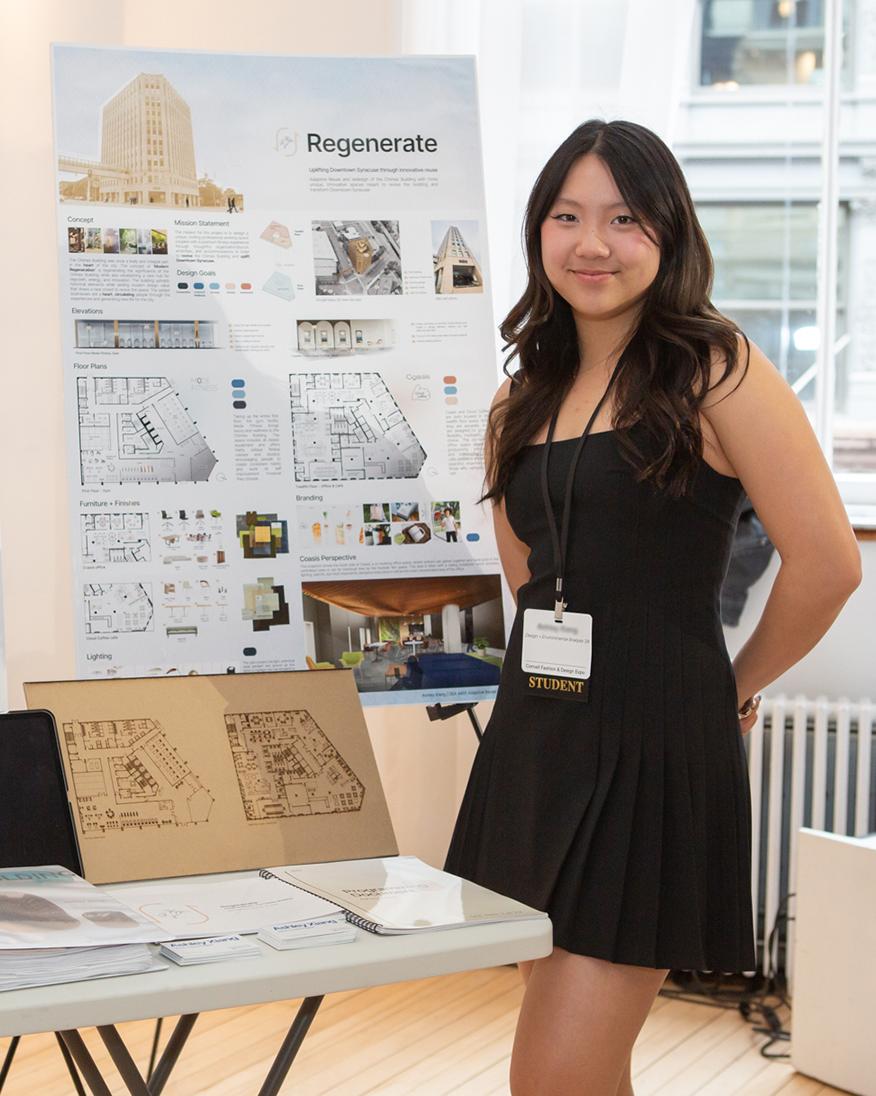
All drawings, models, and student work completed in the studios and other courses as a part of the DEA instructional program are the property of the department until they have been graded and released by the instructor. Certain student work may be selected by the department for retention for accreditation and archival purposes. Exhibitions of student work are often held in Cornell Human Ecology galleries and smaller display cases throughout the CHE building complex.