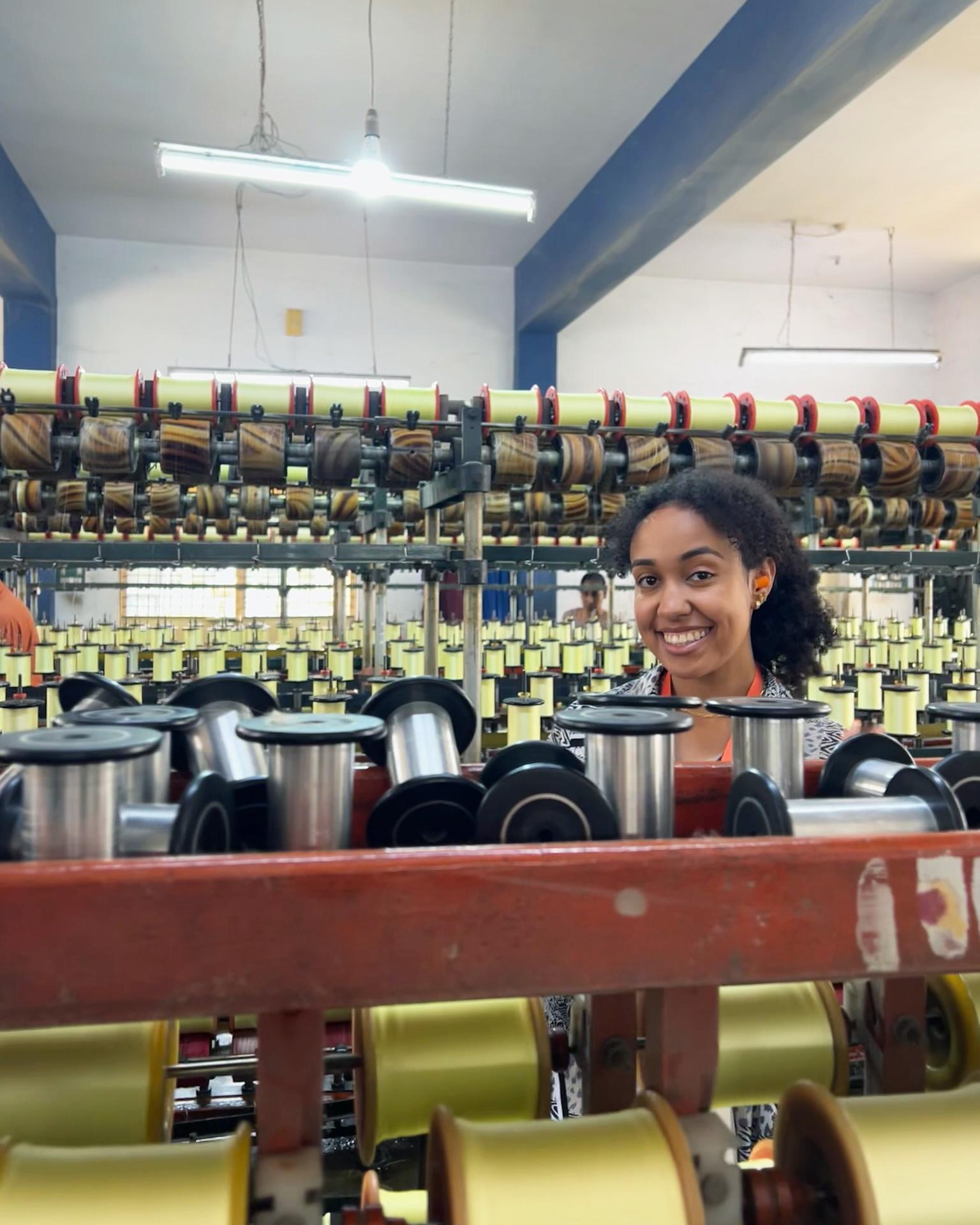
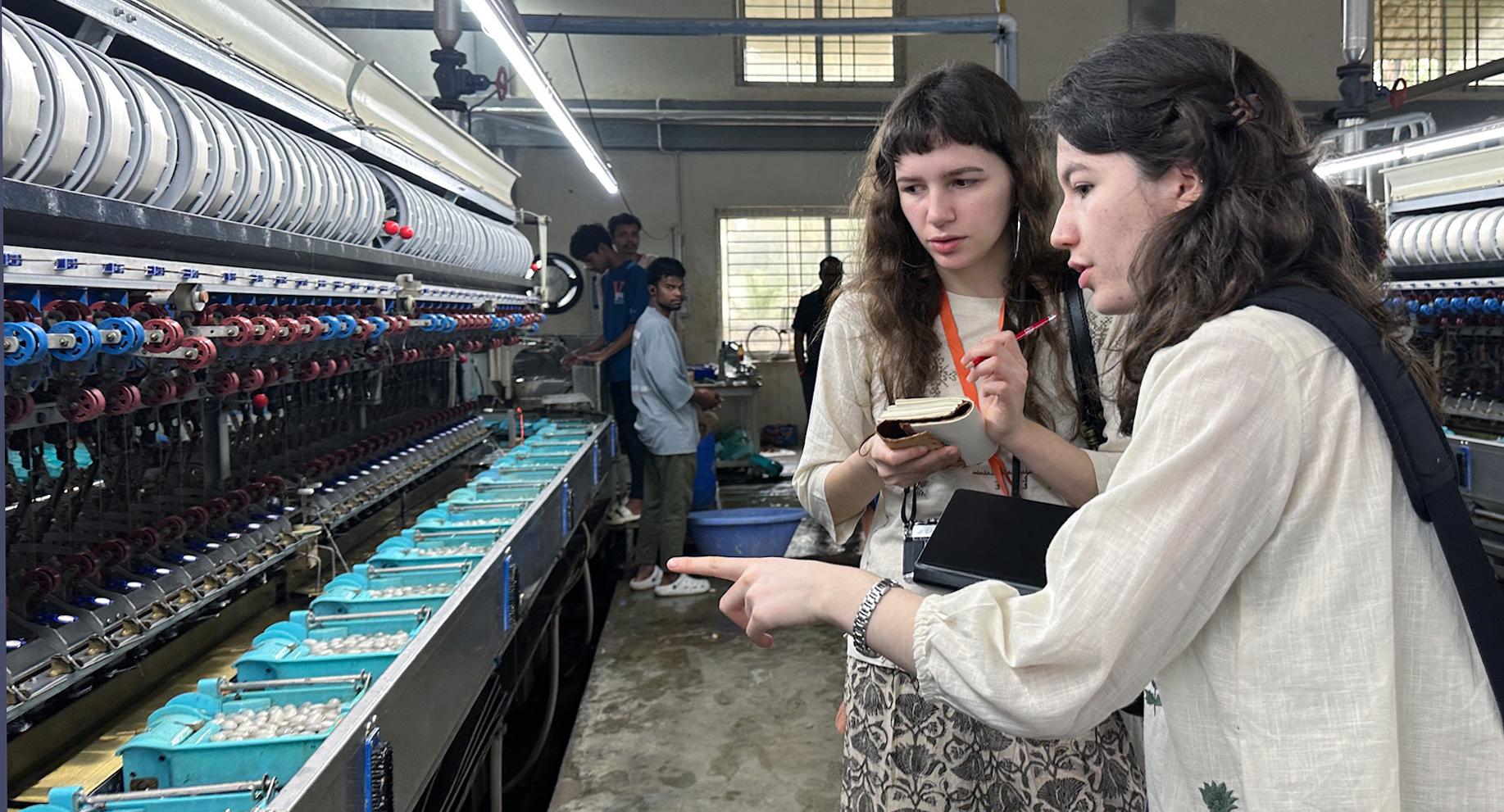
Julia Schanen '26 (left) and Ada Rauber '27 (right) watch silk cocoons being processed at a reeling facility in Kollegal, India. Silk reeling is the process of unwinding raw silk filaments from silkworm cocoons to form threads. Photo by Denise Green.
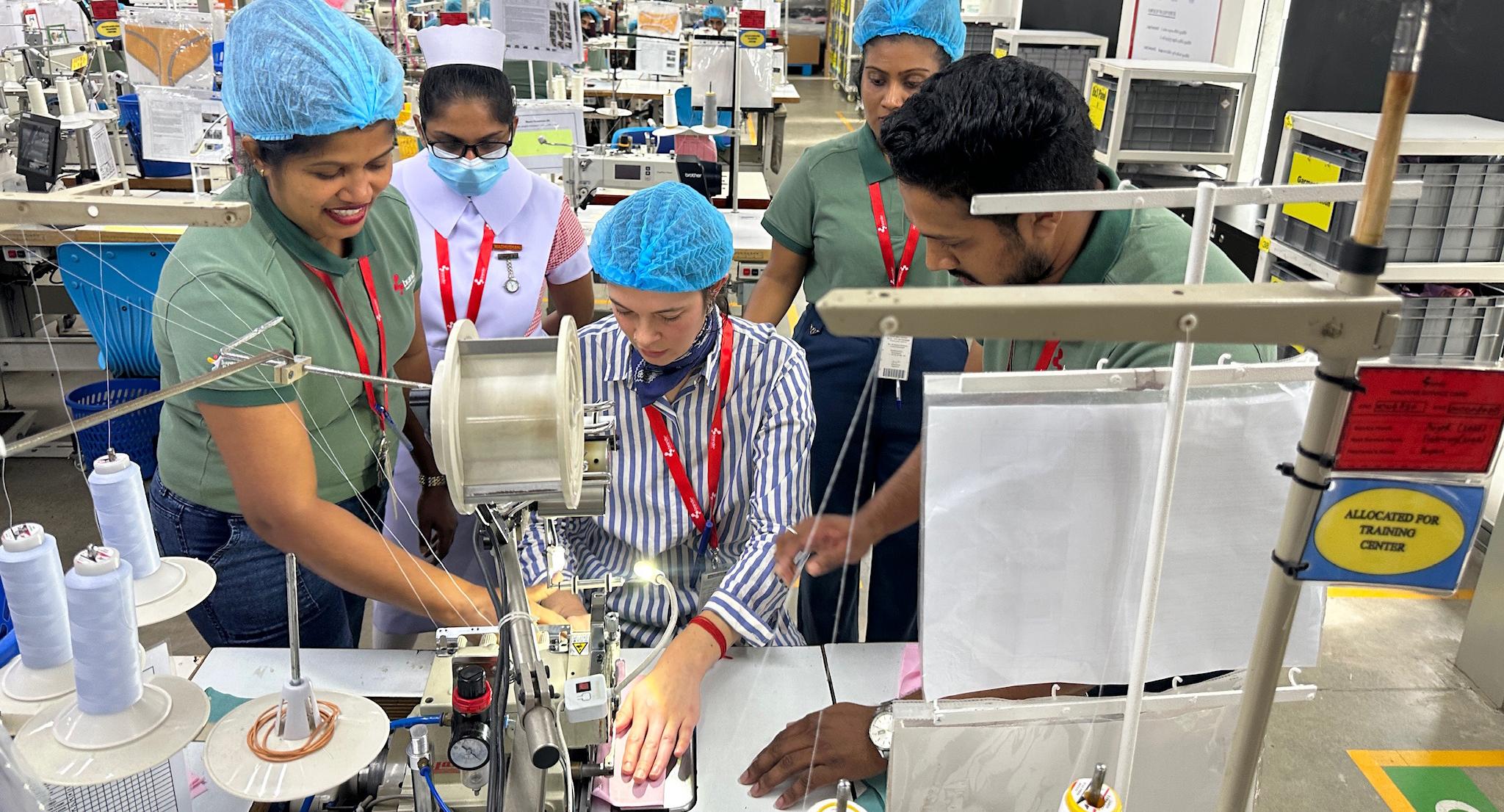
Sephra Lamothe (center) sews underwear as part of a sewing operator training exercise at the Brandix training center in Rambukkana, Sri Lanka. Photo by Denise Green.
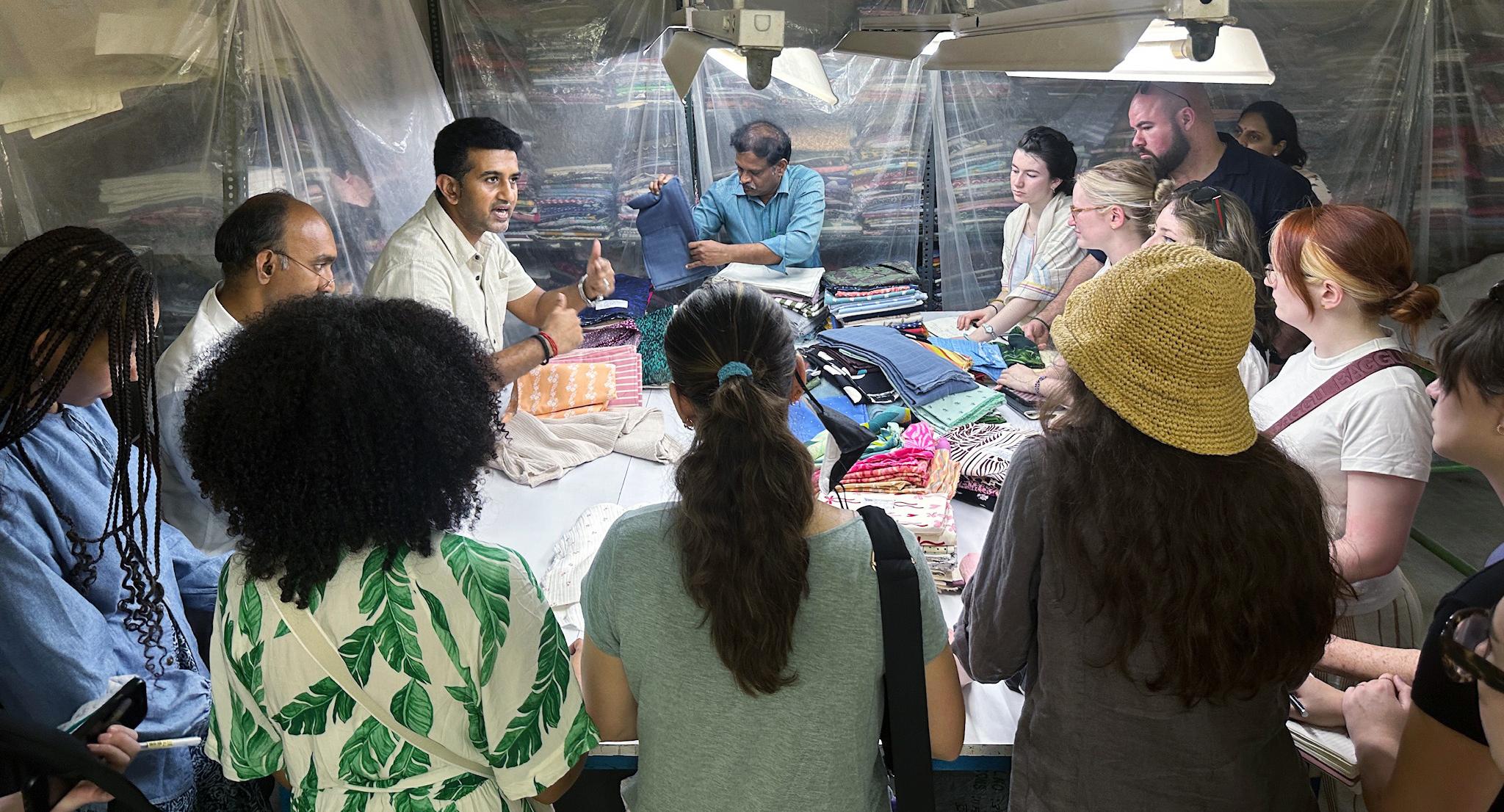
Students examine fabric samples at the SSM Weaving Mill in Tirupur, India. SSM is the largest producer of cotton, linen and rayon textiles in India. Provided.
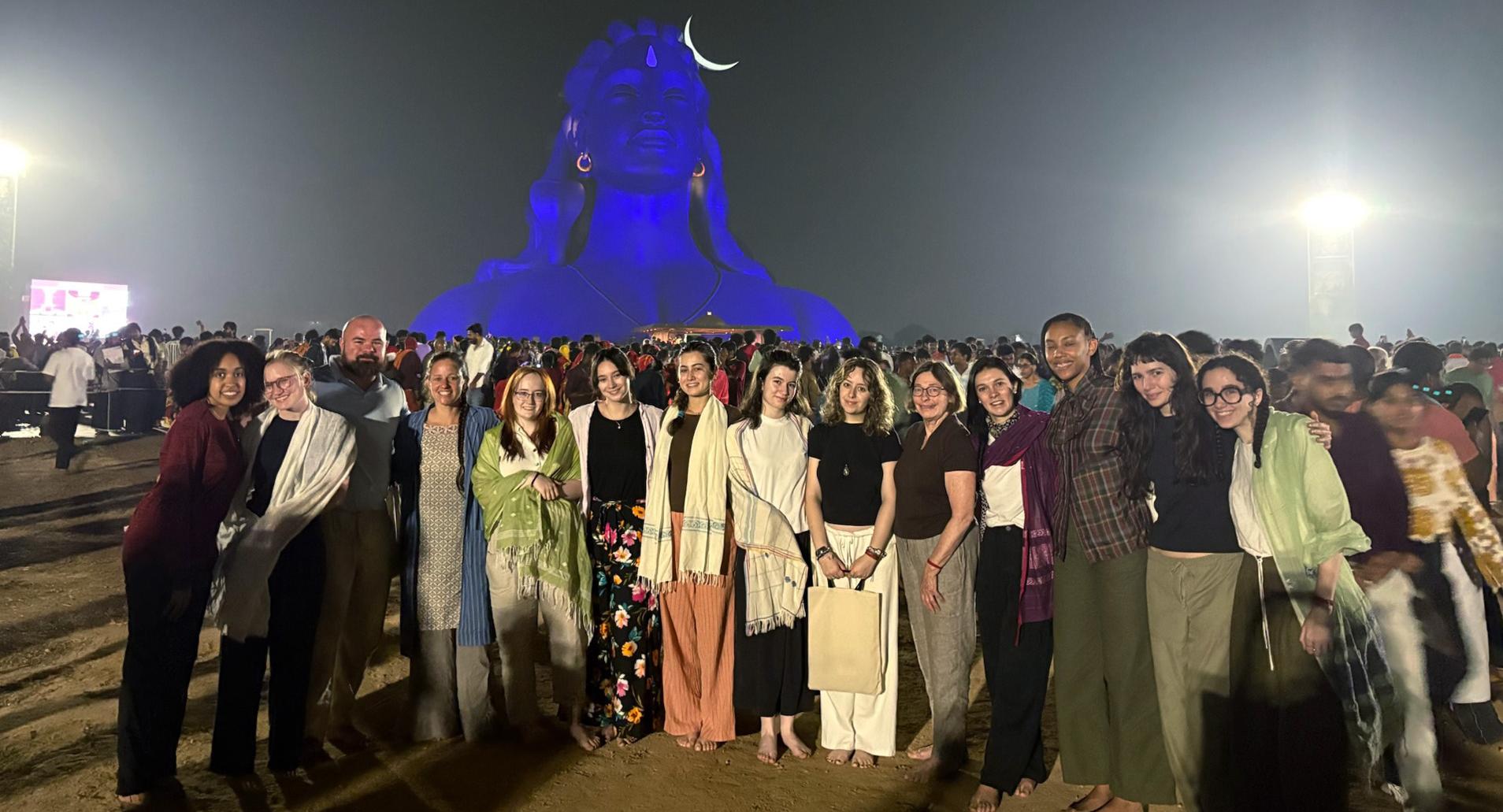
Students and faculty enjoy a spiritual retreat and light show at the Isha Yoga Center in Coimbatore, India. Provided.
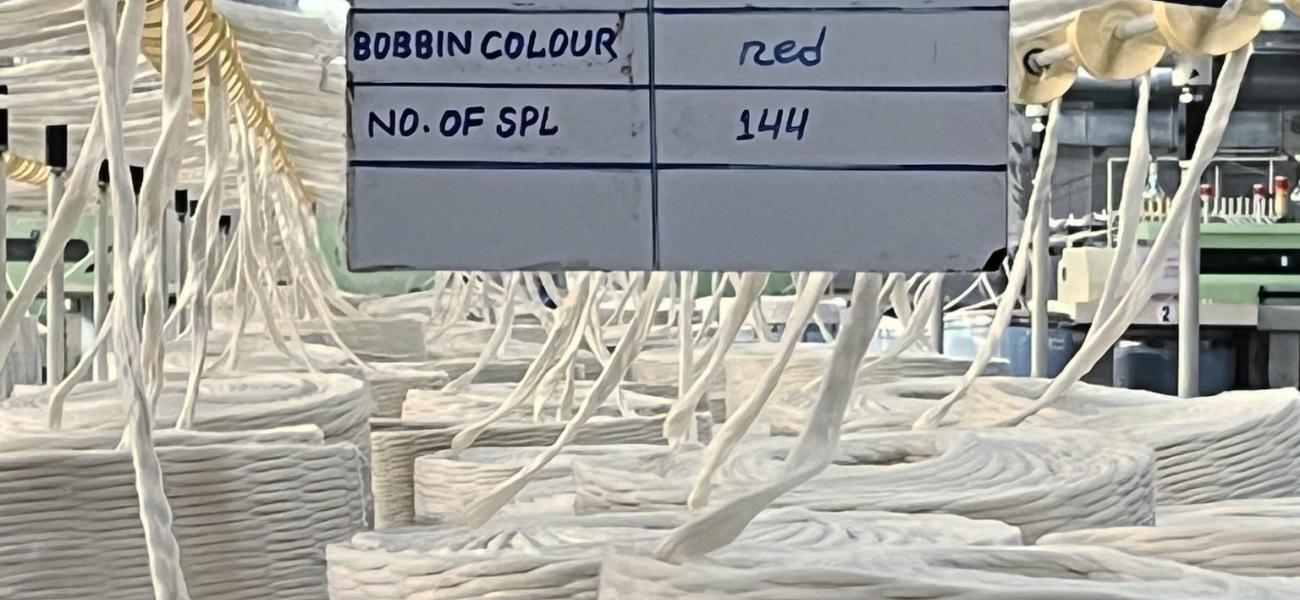
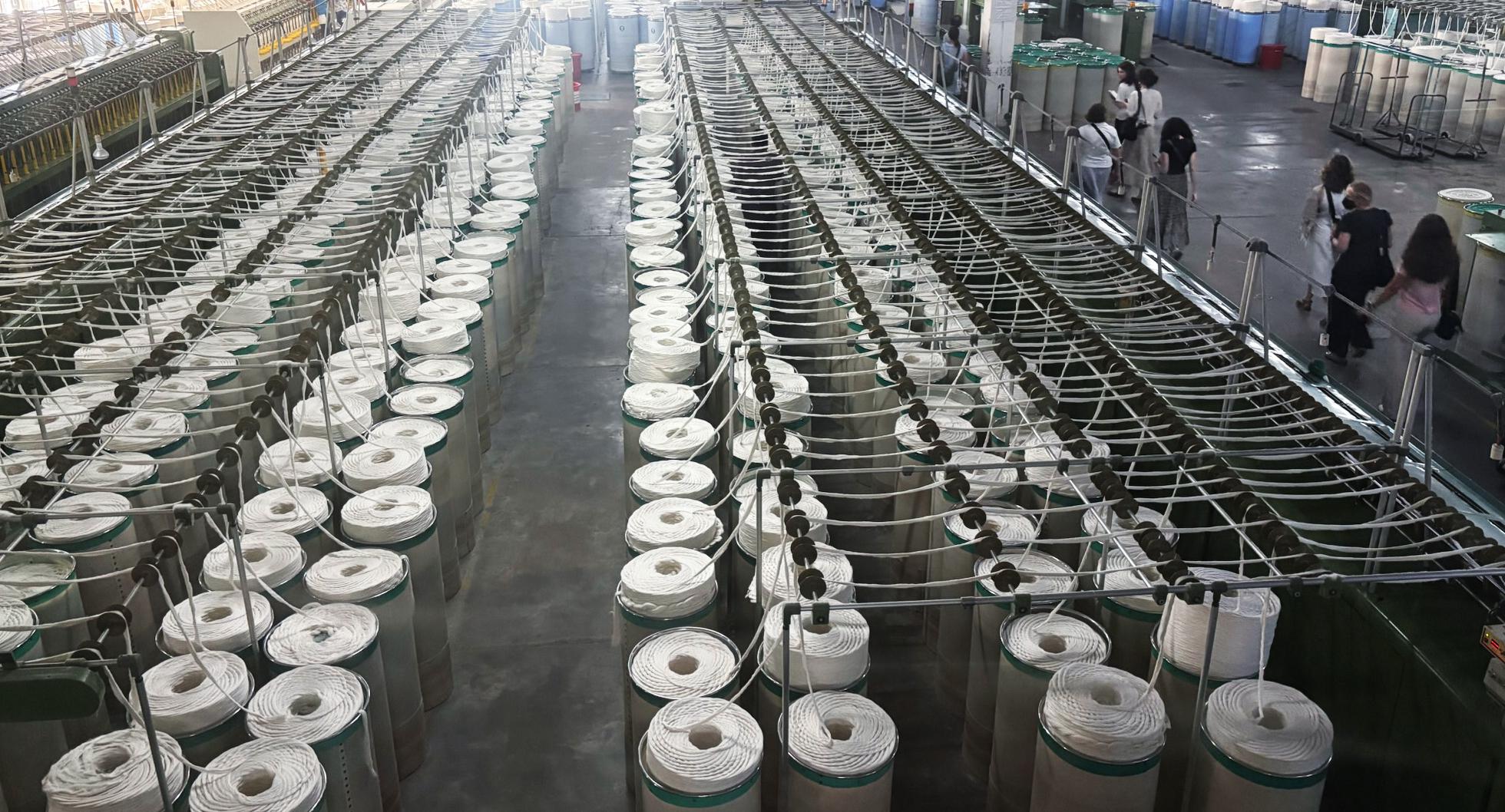
Veejay Lakshmi Textile Division in Thekkampatti Post, Mettupalayam. This facility transforms raw cotton into yarn. Provided.
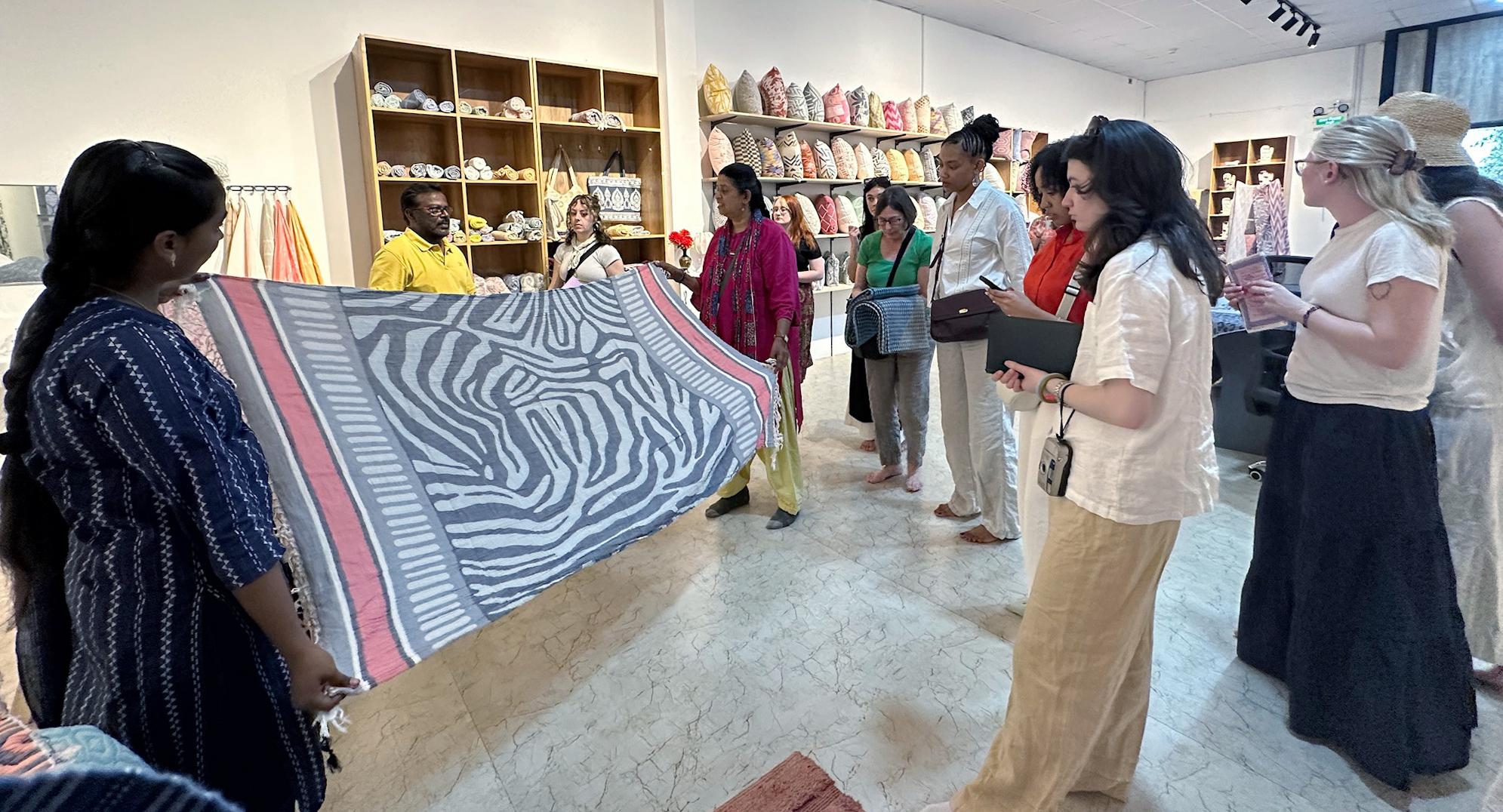
Reviewing textile samples inside the Tech and Tex home textiles showroom in Karur, India. The company operates its own jacquard mill, where intricate patterns are woven directly into the fabric rather than printed on the surface. Provided.
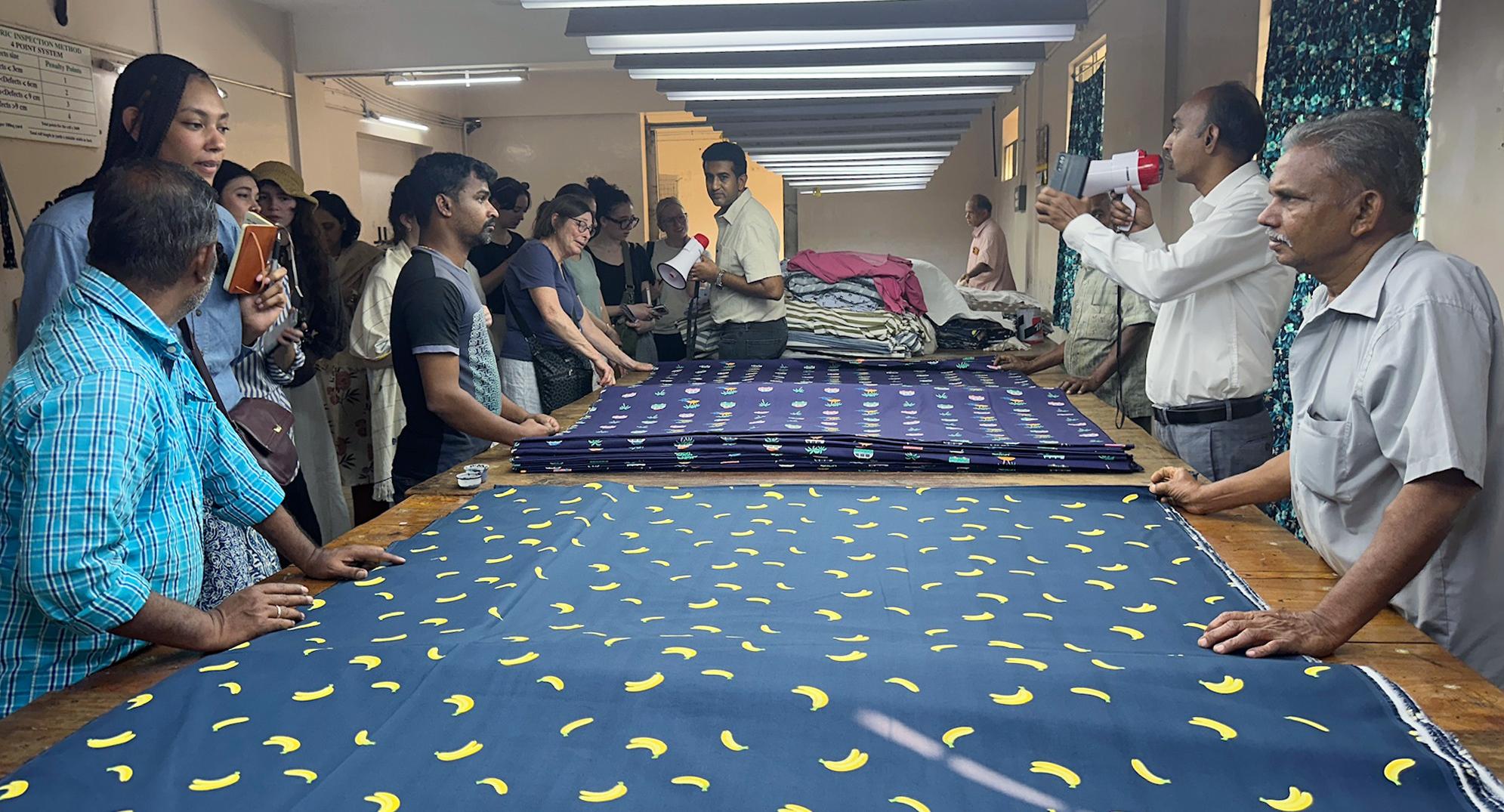
Learning the quality-control process at the SSM weaving mill in Tirupur, India. Provided.
Brandix product development challenge
Brandix is a full-service contractor working from design through production for major apparel brands. For the design challenge during the fall, students worked in four development teams tasked with improving garment flexibility across size, purpose, environment and activity. For example, the leggings team focused on making the garment more flexible for different purposes, creating a prototype that functioned for gym use but was also suitable for daily wear with minor adjustments. As part of the design process, each team had to work within multiple constraints, and students met regularly with Brandix officials during early-morning sessions.
“This project adds a whole new dimension to the experience,” said Fran Kozen, senior lecturer and class co-teacher. “Before we were just seeing processes. Now the students are understanding how to work within industry and manage the limitations of who your client is, balancing complexity and cost. They are really having to think product development.”
While in Sri Lanka, the teams saw their technical designs become functional prototypes at the Brandix factory before presenting their innovations to company leadership.
Students reflect on their field experience:
Optimizing for design and manufacturing
Alexis McMurray ’26, fashion design major
“During class in the fall, I thought they prepared us well for this trip. But after travelling through South Asia, nothing could have prepared me for this,” said McMurry. “It was a culture shock.” McMurray cited the different role gender plays in South Asia. In Sri Lanka 89% of the garment workers are women.
McMurray was on the size flexibility team with Sabrina Kogan ’26 and Jillian Walker ’27. They designed a sports bra that adapts one cup size to comfortably support women as they age. As the design lead, McMurray created the “tech pack,” an industry-standard detailed manual that translates the design into manufacturing specifications.
“Before we went overseas, I submitted our tech pack and created an initial prototype,” she said. “But when we got there, I was really interested in the recommendations that the Brandix team made to improve the standard minute value (SMV) of our product.”
The SMV indicates how long each operation takes to produce a garment. McMurray’s prototype took 90 minutes to construct.
“They made great suggestions for changing the closures and streamlined the production process to 13 minutes. From a design standpoint, it was interesting to see how working together improved efficiency and unit cost.”
Sustainable supply chains require a holistic lens
Imani Bodet ’26, fiber science major
Bodet is interested in making a more environmentally sustainable supply chain. She has previously interned in sustainable materials sourcing with Disney.
“We started in India, and we saw a lot of textile production from fiber to yarn to finished fabric,” she said. “I really liked seeing how the process works. It's a little more disjointed than I expected. Seeing how many steps everything must go through, and how far some of the steps are from each other, was eye-opening.”
The experience allowed Bodet to consider new dimensions for defining sustainability. She noted that sustainable fashion often focuses on materials or dyes but less often examines how materials are sourced, such as the transit time from raw material to finished textile or the energy used to fuel each factory.
“After touring so many facilities in India and Sri Lanka, I think it’s given me a lot to consider regarding sustainability and material production.”
As part of the environmental flexibility team, Bodet worked with graduate students Lauryn Grubbs and Sarah Orsinger to design a bodysuit with moisture-wicking and thermoregulating properties.
“It was great working with the Brandix textiles team to see what materials are available, such as those used in period underwear, because it's absorbent and doesn't feel wet,” Bodet said. “This is something that we wanted to prioritize if you're transitioning, say from a hot day to a workplace with air conditioning.”
Textile production is human-driven
Sephra Lamothe, Ph.D. student in apparel design
“For any students who are debating whether or not to take this class — do it,” said Lamothe. “It is a once-in-a-lifetime experience, having those factories and workshops open to us and seeing the variety of stages that go into producing one single garment. To learn from the artisans and expand your knowledge of the production process, which we often take for granted, is amazing and I am grateful to the Khaitani Family Foundation.”
Lamothe studies fashion history and fashion labor.
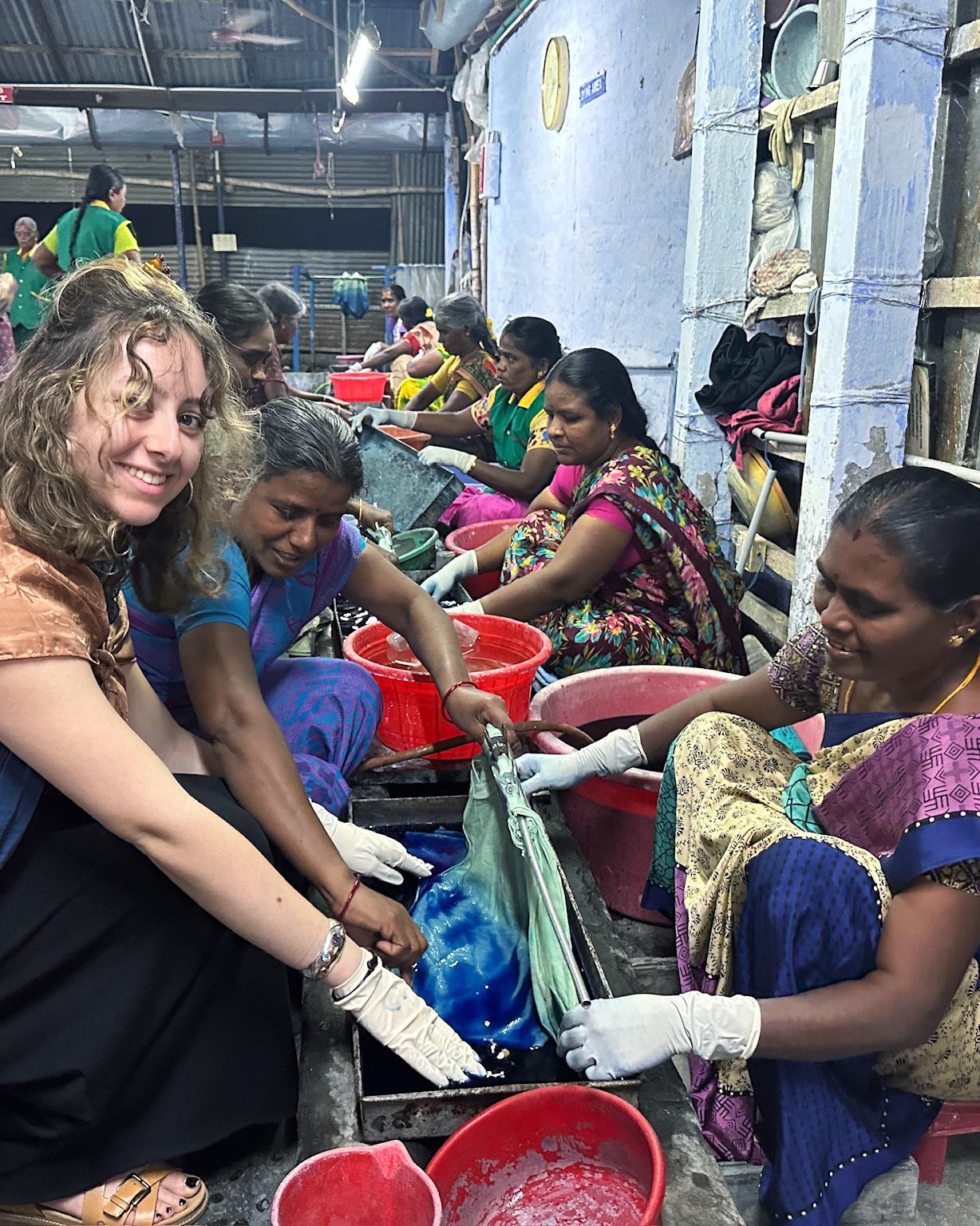
“As a fashion historian who studies labor, I consider how many hands touch each garment, and the individuals behind them,” said Lamothe. “One highlight was visiting the Greenland Textile tie-dyeing facility. It was our last stop of the day and they made dinner for us.”
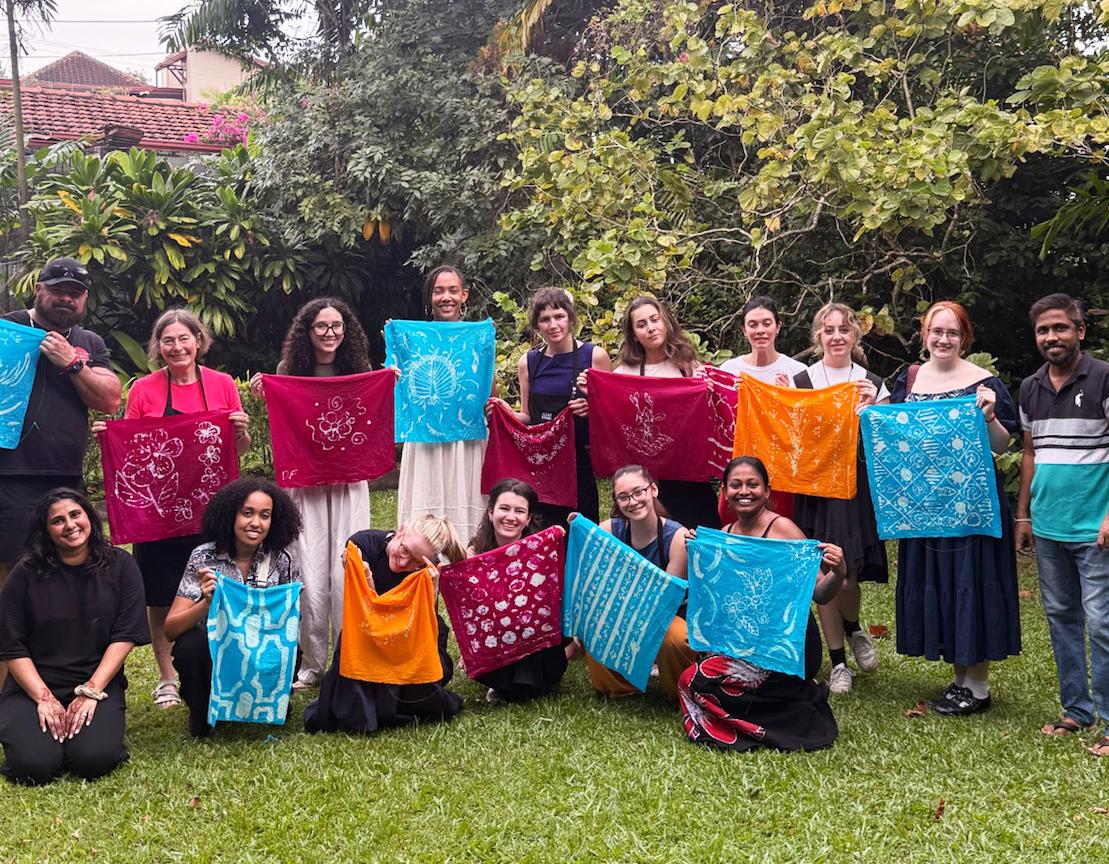
During the visit, the class was able to try tie-dyeing by hand, which is Greenland’s specialty. Afterward, they shared dinner with the employees and looked at photos from previous trips.
“I was able to look at sample garments with a lot of the workers who constructed them,” Lamothe said. “It was a unique opportunity, because it was one of the rare times where we had the ability to just sit, relax and get to know others.”
More media
Want to see more videos about textile production? Check out the class travelog on Instagram.
The class wishes to thank the HCD staff who worked behind the scenes to make this trip happen.