


News, Profiles
and Moments
See what's new at CHE, on campus and beyond.
HCD Uyar Lab FS 2025
O'Callaghan Maeve HBHS 2025
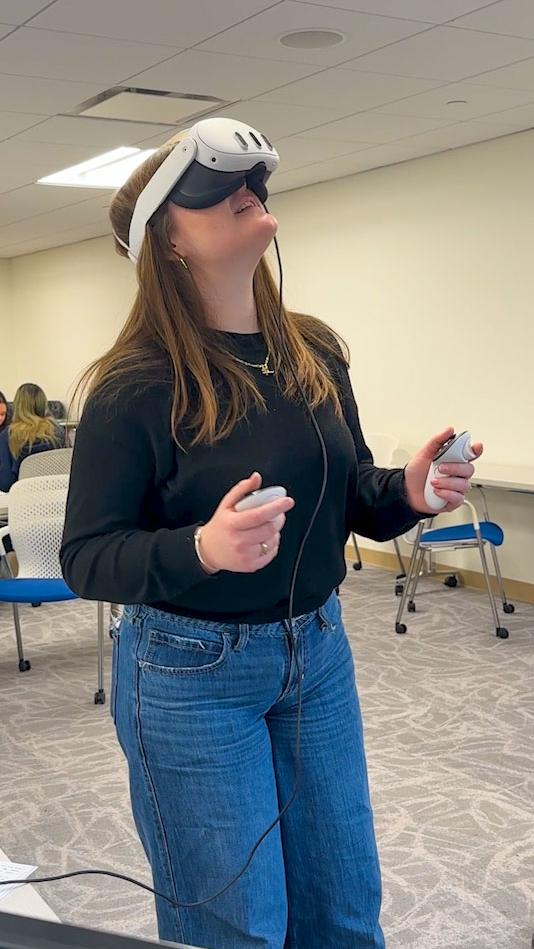
Applied Anatomy and Physiology is a really cool class I got to take this fall. It’s being offered for the first time, and it was really cool to learn a bunch of clinical skills that are related to anatomy that I've learned in previous classes. Not only do we learn how to do different clinical exams, but we also learn the underlying anatomy mechanisms that give context of why we do things the way we do, and also some potential abnormalities that we might find on these kind of exams. It's also been really cool to have such a hands-on class. We use VR in a variety of different instruments to really engage deeply with the material that we've learned. Dr. Barre is also the best possible person that could have taught this course. Not only is she so knowledgeable, but she’s so committed to making sure that everyone understands all the concepts that we learned in class.
DNS Kwok Ethan GHPS 2025
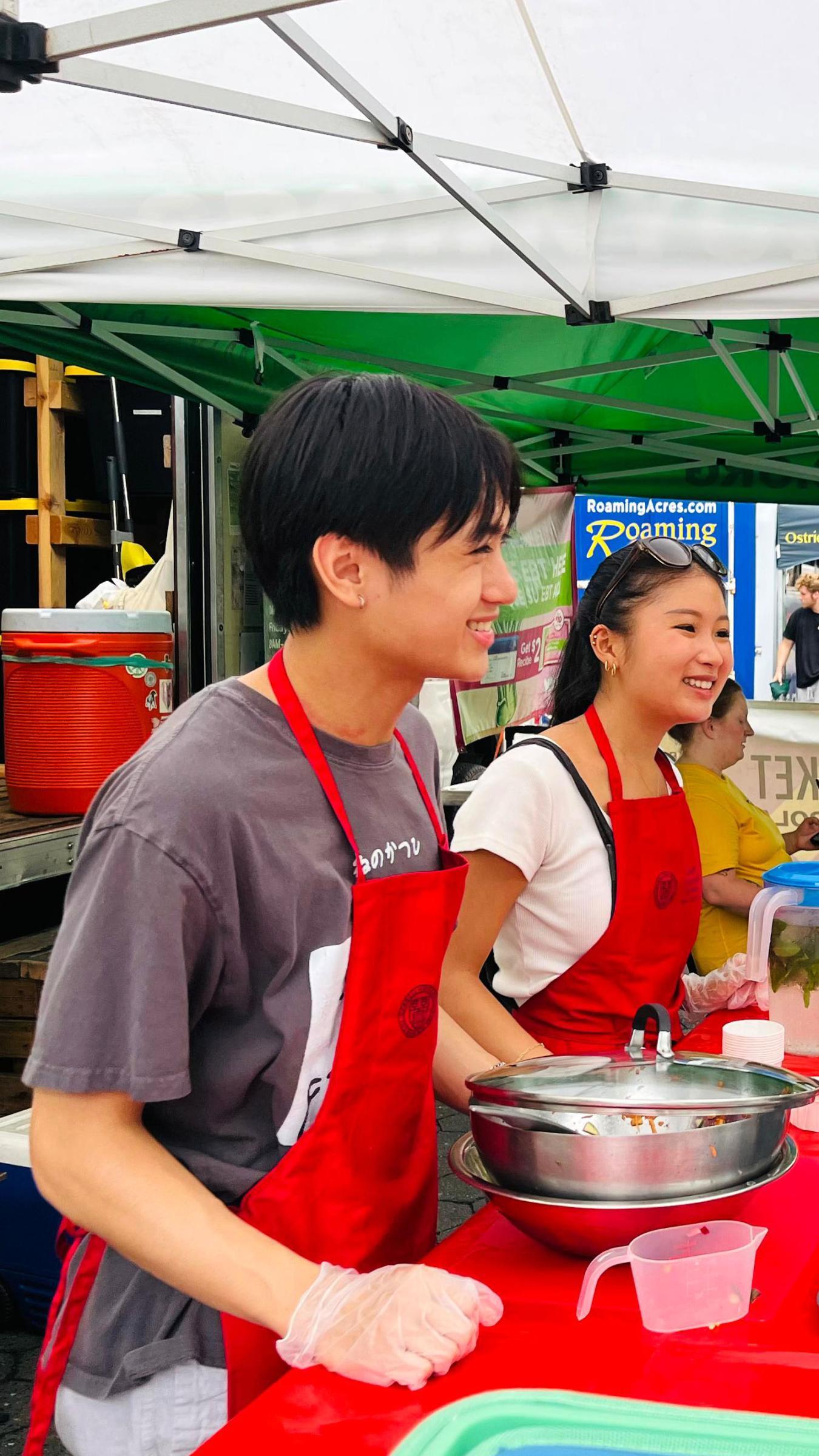
Over the summer, I interned with the Farmers’ Market Nutrition Program under the Cornell
Cooperative Extension. The main mission of the Farmers’ Market Nutrition Program is to enhance the health of at-risk New Yorkers such as low-income communities and senior citizens, and to also promote nutrition education and food skills for everyone overall. Growing up in New York City, there are a lot of neighborhoods which I have never explored before, and this internship gave me the opportunity to engage with communities which I have never engaged with before. One of the main takeaways from this internship was how to be culturally competent in public health settings, because it's crucial to have an open mind and be ready to unlearn any biases to share meaningful stories and to truly engage with the communities you serve. This was a very valuable experience because it was amazing to see how how many community members were grateful to learn new ways to build healthy habits, and to build a balanced diet.
Cooperative Extension. The main mission of the Farmers’ Market Nutrition Program is to enhance the health of at-risk New Yorkers such as low-income communities and senior citizens, and to also promote nutrition education and food skills for everyone overall. Growing up in New York City, there are a lot of neighborhoods which I have never explored before, and this internship gave me the opportunity to engage with communities which I have never engaged with before. One of the main takeaways from this internship was how to be culturally competent in public health settings, because it's crucial to have an open mind and be ready to unlearn any biases to share meaningful stories and to truly engage with the communities you serve. This was a very valuable experience because it was amazing to see how how many community members were grateful to learn new ways to build healthy habits, and to build a balanced diet.
PSYCH Iwasko Julian HD 2025
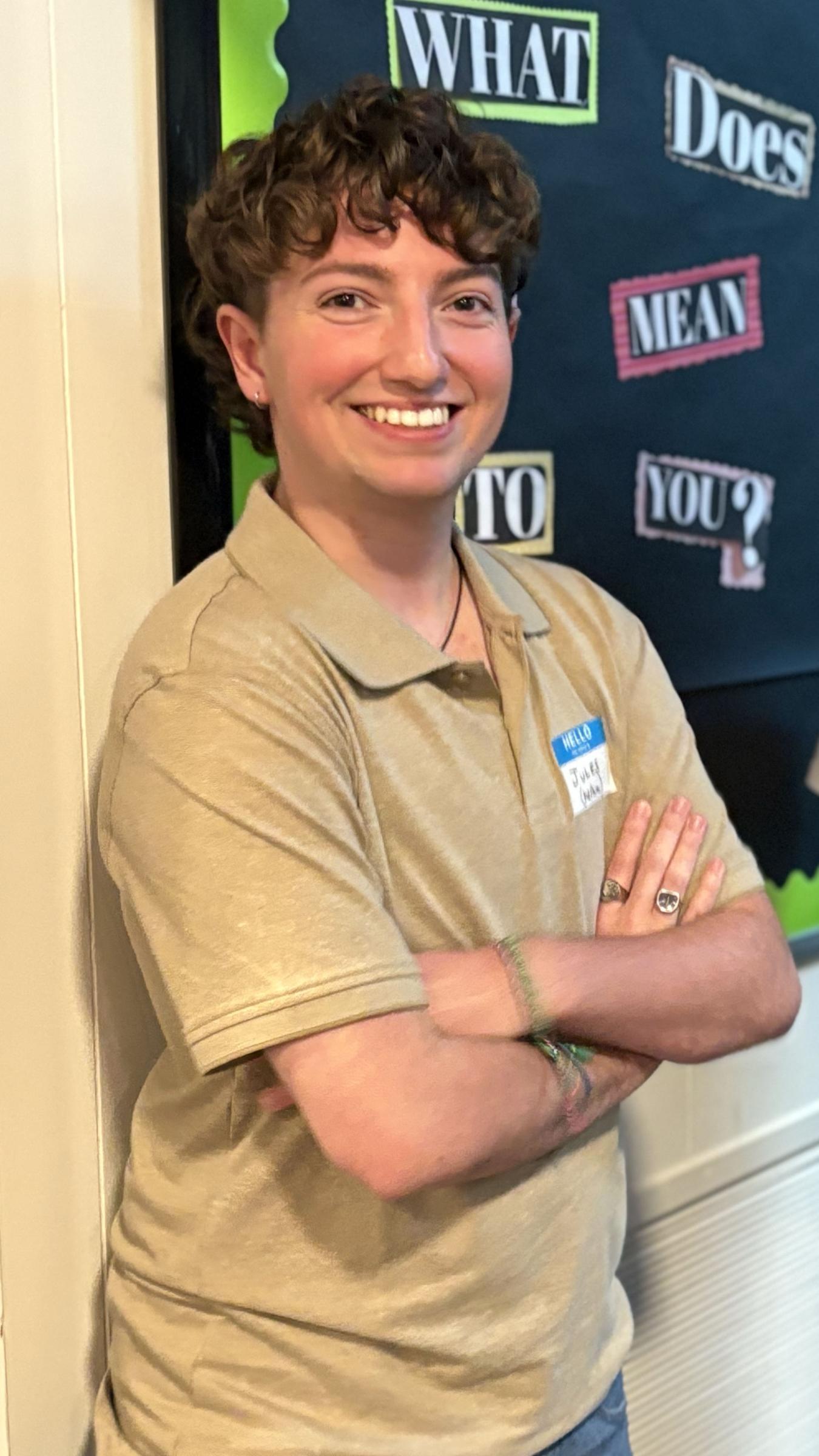
The Chosen Family art exhibit came out of months of collaboration with our two community partners, the Ali Forney Center and the Q Center. Both of these centers serve LGBTQ+ young people, who face family rejection, housing instability and a lack of social support.
We invited youth from the centers to create art reflecting the meaning of chosen family in their lives. And in September, we invited them to the centers for a night of recognition, where they told stories about how they’ve built care networks in their lives and celebrated chosen family. Every piece you see in this gallery is from a young adult or a youth from one of these centers. This exhibit is part of our PRISM study, which is a three-year longitudinal study looking at LGBTQ+ adolescent identity development and what factors help
or hinder that process. Importantly, the decision to study chosen family came directly from our community partners. For me, this process showed what translational research looks like when it's done in genuine partnership. These young people are more
than just research participants. They're artists, storytellers and knowledge holders, and their experiences guide our research just as much as we study it.
We invited youth from the centers to create art reflecting the meaning of chosen family in their lives. And in September, we invited them to the centers for a night of recognition, where they told stories about how they’ve built care networks in their lives and celebrated chosen family. Every piece you see in this gallery is from a young adult or a youth from one of these centers. This exhibit is part of our PRISM study, which is a three-year longitudinal study looking at LGBTQ+ adolescent identity development and what factors help
or hinder that process. Importantly, the decision to study chosen family came directly from our community partners. For me, this process showed what translational research looks like when it's done in genuine partnership. These young people are more
than just research participants. They're artists, storytellers and knowledge holders, and their experiences guide our research just as much as we study it.
DNS_Whidden_Laurel GPHS 2025
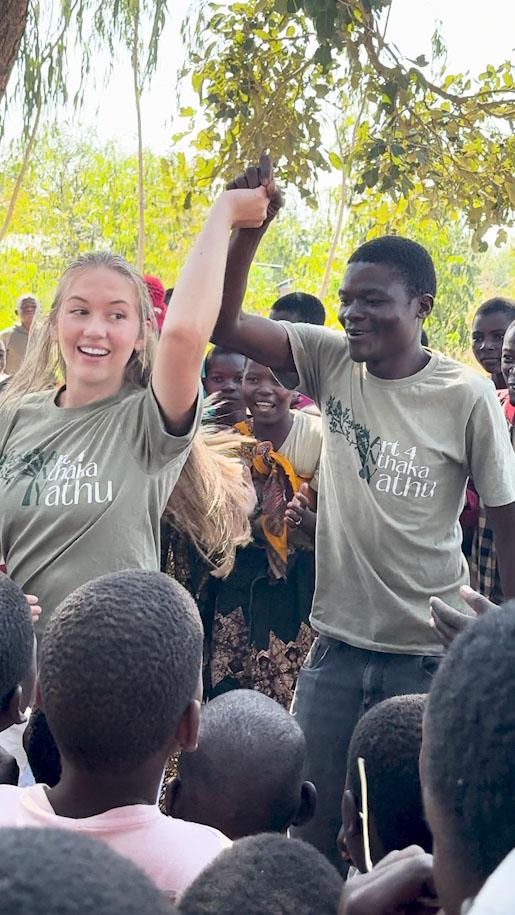
Two years ago, I arrived in Zomba, Malawi, and my goal was simple: to understand challenges communities were facing and to see how art could help improve lives. The first summer I spent in Malawi, I launched Art4NthakaYathu, which means art for our land in the local language chichewa. It is a climate justice project where art and public health intersect. I spent my days talking with youth climate champions, village chiefs and community leaders, learning how climate change was affecting food, water, health and culture. Together with my mentor, Rodger, and the ArtGlo team, we guided 15 youth to design projects that address these challenges. After I departed that summer, youth continued to lead. They planted over 1,250 native trees, improving soil, water and community spaces. The next summer, I returned with a bigger goal: to expand Art4NthakaYathu. We brought in students from three
local schools across the district and paired them with our original youth climate champions as mentors. Despite shifts in funding, support from Cornell Human Ecology and a GoFundMe campaign I created helped us keep the program running. Students designed creative, actionable climate projects, presented them to village leaders and even received seed funding to make their ideas real. Through role plays, murals and creative exercises, students explored climate change, health and local solutions in ways that felt hands-on and meaningful. It reminded me that even across continents,
creativity, connection and care can spark real change.
local schools across the district and paired them with our original youth climate champions as mentors. Despite shifts in funding, support from Cornell Human Ecology and a GoFundMe campaign I created helped us keep the program running. Students designed creative, actionable climate projects, presented them to village leaders and even received seed funding to make their ideas real. Through role plays, murals and creative exercises, students explored climate change, health and local solutions in ways that felt hands-on and meaningful. It reminded me that even across continents,
creativity, connection and care can spark real change.

HCD Mueller Schrader Tabitha Abrol Maya FDM 2025
As student research assistants in the Cornell Fashion and Textile Collection, we were very excited when Lieutenant Colonel Fitzpatrick invited us to collaborate with the Wortham Museum in Barton Hall. Over the course of
the past three months, we've worked to comprehensively catalog the hundreds of items
housed in their military science collection. After wrapping up the inventory process, we began the curatorial stages of the Fit for Duty exhibition, in both the Wortham Museum and the Human Ecology exhibit spaces. While the exhibit in the Wortham Museum focused primarily on the legacy of Cornell’s ROTC program and military history, the exhibit in Human Ecology looks at how military uniforms have shaped the aesthetic development of contemporary fashion, silhouettes and identities. As a senior whose worked in the Cornell Fashion and Textile Collection for four years now, it’s been so amazing to have the opportunity to be deeply involved with this project, from start to finish.
the past three months, we've worked to comprehensively catalog the hundreds of items
housed in their military science collection. After wrapping up the inventory process, we began the curatorial stages of the Fit for Duty exhibition, in both the Wortham Museum and the Human Ecology exhibit spaces. While the exhibit in the Wortham Museum focused primarily on the legacy of Cornell’s ROTC program and military history, the exhibit in Human Ecology looks at how military uniforms have shaped the aesthetic development of contemporary fashion, silhouettes and identities. As a senior whose worked in the Cornell Fashion and Textile Collection for four years now, it’s been so amazing to have the opportunity to be deeply involved with this project, from start to finish.

PSYCH Woods Promise HD 2025
So here at the Play and Learning Lab, we're really interested in early childhood cognition and how children learn through play, how parents can scaffold children’s learning and their speech acquisition through everyday means.
I personally really enjoy the lab because I get to play with infants every day. I've gotten to code, I’ve done participant recruitment and now I get to lead some of my own projects. I have a deep passion for early childhood education and working with infants, and that’s my favorite part about being part of the Play and Learning Lab.
I personally really enjoy the lab because I get to play with infants every day. I've gotten to code, I’ve done participant recruitment and now I get to lead some of my own projects. I have a deep passion for early childhood education and working with infants, and that’s my favorite part about being part of the Play and Learning Lab.

HCD Diogenous Iason DEA 2025
HCD Chesson Eskyla FM 2028

HCD Agran Jess FD 2027

DNS Zhang Daniel NS 2025
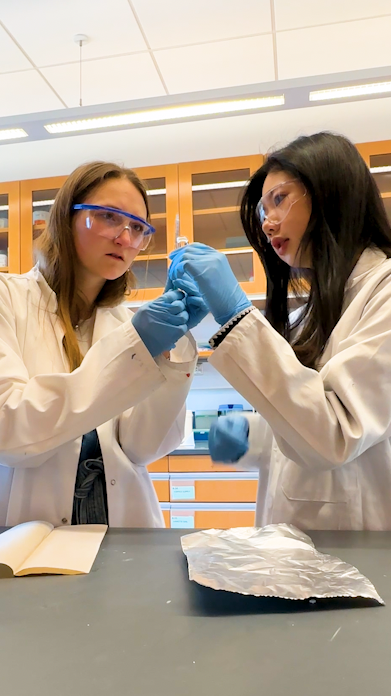
This semester, I'm taking NS3320 with Dr. Field, called Methods in Nutritional Sciences. And today we did a hematology lab looking at our own blood samples. Here's my blood. So after we got our blood drawn today,
we centrifuged, or spun down, our samples and that separated out the plasma in the serum from our actual red blood cells. So then we can isolate the serum, and next time, look at our iron levels, to see if there's anyone who has iron deficiency anemia or other diseases. We looked at our blood glucose levels, which was really cool to see. And I have never figured out what my blood type was, so it was cool to see that I’m B positive, which is a good mantra for
life, just to be positive.
we centrifuged, or spun down, our samples and that separated out the plasma in the serum from our actual red blood cells. So then we can isolate the serum, and next time, look at our iron levels, to see if there's anyone who has iron deficiency anemia or other diseases. We looked at our blood glucose levels, which was really cool to see. And I have never figured out what my blood type was, so it was cool to see that I’m B positive, which is a good mantra for
life, just to be positive.
DNS Thoma Eli GPHS 2025