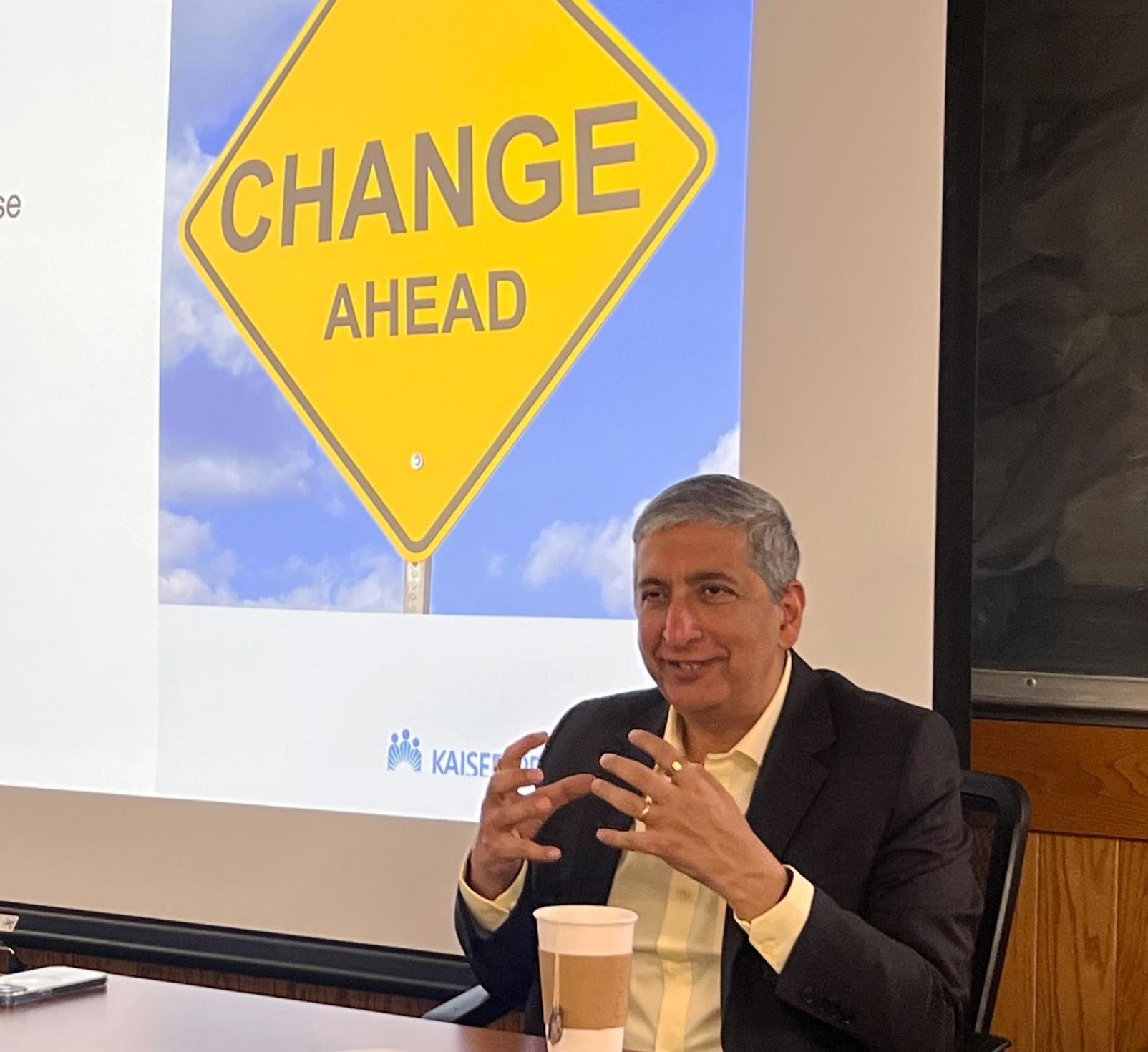
Last week Yazdi Bagli, executive vice president of IT and business enterprise services at Kaiser Permanente, spoke to students in DEA 4500 Policy Meets Design: High-impact Facilities of the 21st century and met with students from the Health Design Innovation Lab, directed by Rana Zadeh. This marks Bagli’s third year returning to campus to speak with and mentor our students.

Bagli discussed the differences between systems thinking and design thinking, and the importance of integrating both methods. He emphasized the importance of placing the patient at the core of all decision-making, using a value-focused approach to deliver services efficiently and effectively.

“I see human centered design thinking and systems thinking as closely aligned,” said Bagli. “How do we design so that it works, and it is going to be seamlessly used? Let’s not try to solve a problem in a silo. Let's step back and make sure we are looking at every aspect of the usage, every aspect of the problem, and trying to solve in a way that is sustainable.”

Kaiser Permanente is a nonprofit health system dedicated to delivering high quality, affordable healthcare to patients and the communities it serves. Bagli leads all aspects of IT and shared business services across the system, which includes 40 hospitals and 616 medical offices. In his role overseeing shared services, he highlighted the importance of keeping patients and clinicians at the center, while cautioning against the cycle of a cost-cutting mindset in place of a value-added approach.

Posted on
11/13/2025
Tags
Holistic Human Health, Technology + Human Thriving

I see human centered design thinking and systems thinking as closely aligned. How do we design so that it works, and it is going to be seamlessly used? 

Yazdi Bagli
EVP, Kaiser Permanente

“This talk really resonated with me,” said Ivie Zhang, a master’s student in design. “I come from a background in architecture and healthcare. But hearing his message, which includes information science and business, and the importance of changing the work to more of a value proposition—that could make our research or effort more impactful, which is really powerful.”

DEA 4500 is taught by Rana Zadeh, associate professor in the Department of Human Centered Design. The course examines how well-designed environments and policies empower people, organizations and communities to achieve their objectives, drawing students from design, health, hospitality, business and policy fields. Zadeh employs a flipped-classroom approach, meaning students watch pre-recorded lectures and classroom time is devoted to facilitated discussions including industry leaders like Bagli.

“The integration of pedagogy with industry and community partnerships deeply enriches our students’ learning and prepares them for industry,” said Zadeh. “We are grateful to Kaiser Permanente for their collaboration and engagement including leaders Yazdi Bagli and Jay Koo, M.B.A. ’03. These experiences challenge and inspire our students.”