


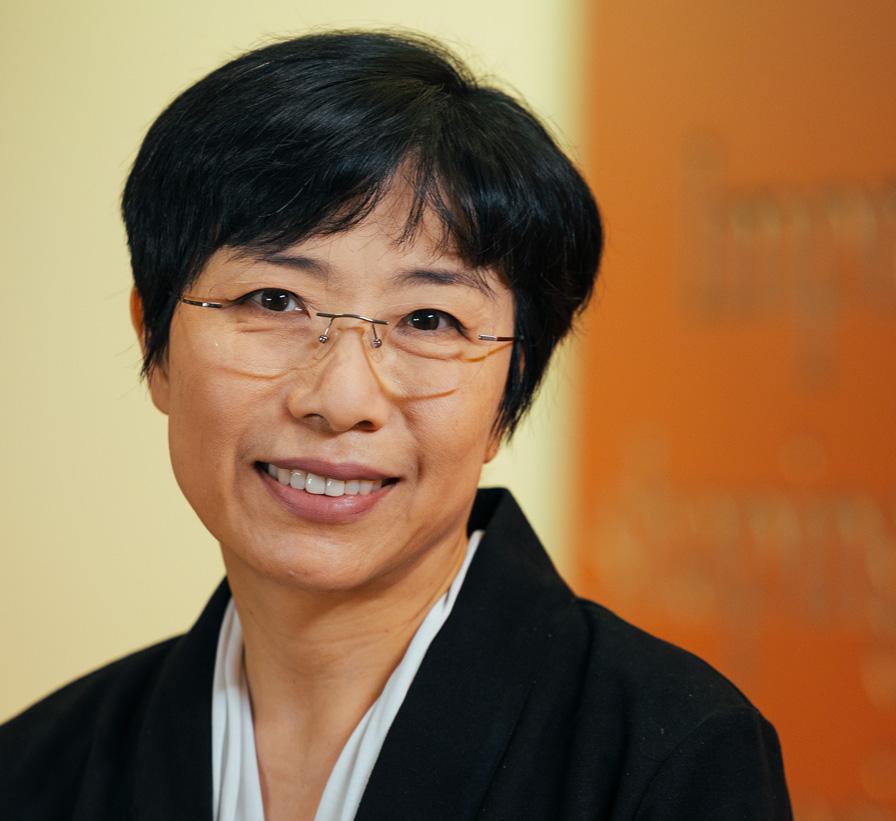
Jung-hye Shin, a design researcher and academic leader, has been named professor and chair of the Cornell Human Ecology (CHE) Department of Human Centered Design (HCD).
Shin comes to Cornell from the University of Wisconsin–Madison, where she served as chair and professor in the Department of Design Studies and as faculty director of design at the Center for Design and Material Culture.
For Shin, this is a return to the Hill. She earned her M.S. in design and environmental analysis from Cornell in 2001 before completing a Ph.D. in architecture at the University of Wisconsin–Milwaukee. She then joined the faculty at the University of Wisconsin–Madison, where she built a distinguished career focused on how to design homes and communities to improve human health and wellbeing.
“I am thrilled to welcome Jung-hye back to Cornell Human Ecology as department chair,” said Rachel Dunifon, Rebecca Q. and James C. Morgan Dean of CHE. “Her vision and expertise will strengthen HCD’s interdisciplinary work in advancing design for human thriving and environmental sustainability.”
Shin began her role on July 1. She follows Juan Hinestroza, the Rebecca Q. Morgan ’60 Professor of Fiber Science and Apparel Design, who served as interim chair for the past year. During this time, Hinestroza documented key department processes, including detailed course mapping, to support Shin as she transitions into the role.
Yasser Gowayed, who retired on June 30, was chair from 2019-2024. During his tenure, he merged the departments of Design and Environmental Analysis and Fiber Science and Apparel Design, forming the interdisciplinary Department of Human Centered Design to expand their design reach.
Shin took time to answer a few questions about her work as she settles into her new role.
You are returning to Cornell, where you earned your master’s degree. What drew you back to Ithaca?
My reasons for coming back to Cornell are twofold. First, as a design educator, Cornell’s Department of Human Centered Design and the thought leaders here are deeply significant. It’s a great opportunity (and challenge) to return and lead a premier design department.
Second, Ithaca is the first place I lived when I began my American experience. Its natural beauty is remarkable. It feels like coming home.
What is your research focus?
My focus is on designing environments where people not only survive but thrive. Environmental design has enormous power to shape people’s lives. I primarily focus on older adults. As our functional capacity declines, we become more sensitive to environmental opportunities and limitations. As designers, we can support aging in place at every scale from urban planning to building design to micro-design such as personal products or even door thresholds. To succeed in designing for aging in place, we must take an interdisciplinary approach.
Why did you become a design educator?
I practiced in Korea for several years before pursuing my master’s degree at Cornell. Working mainly for architectural companies, I often questioned my designs, wondering, “How might my design shape the way people experience and interact with this building?” I became aware of the social responsibility that designers carry, and that motivated me to want to learn more.
The academic transition to design research was intense and enjoyable. But the challenge with research is that it can take many years for evidence to influence practice. The beauty of design education is the dual pathway between research and teaching. It’s powerful to work with students who will become pioneering practitioners.
Is there anything you’re especially looking forward to?
Working collaboratively across a community like CHE, that’s focused on social justice, sustainability and enhancing human potential, demonstrates the power of translational research.
It’s a privilege to support the world-class faculty and students in HCD who are designing with a higher-level purpose.
Posted on
07/28/2025
Author
Tags
Holistic Human Health,
Social Impact + Justice,
Sustainability + Society,
Technology + Human Thriving
Share


