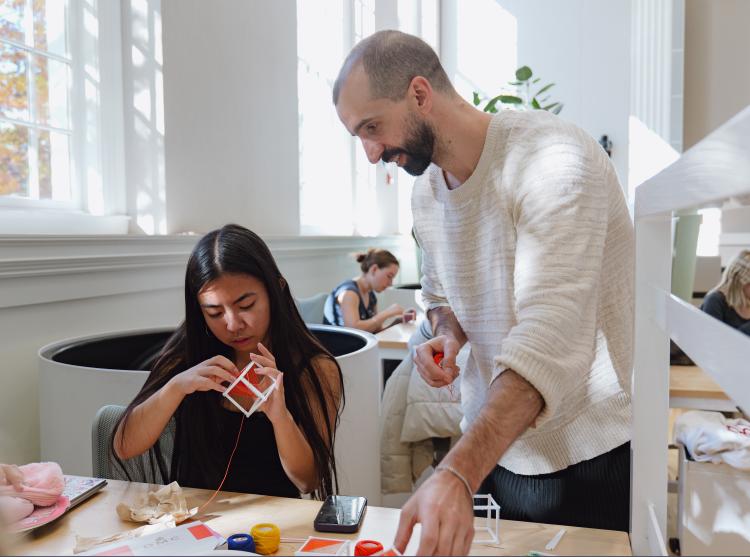


From gallery to lecture hall, Fitch shared how he uses small elements to create extraordinary forms
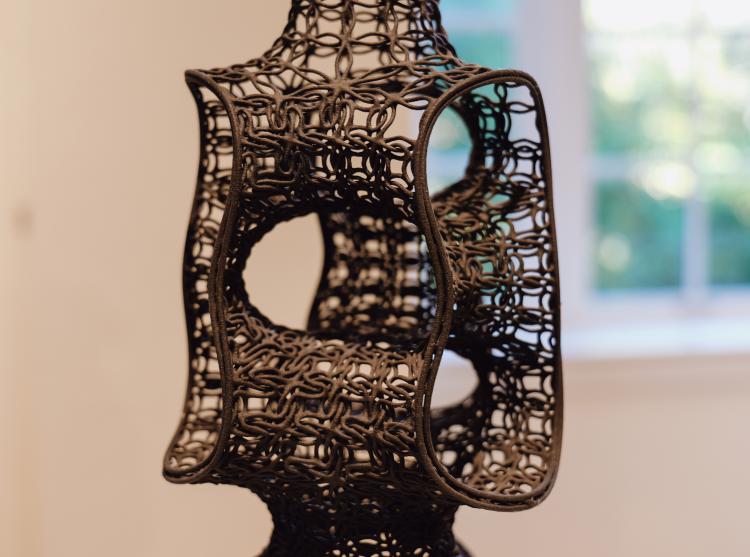
Fitch’s iterative approach was visible across the residency, including in “Accumulations,” an art exhibit spanning more than a decade of his practice. From fashion to product design, he showcased how simple repeated elements can create unexpected visual effects, such as a color-shifting dress inspired by a butterfly's wings and a series of colorful 3D-printed pixels on fabric.
His public lecture offered a more technical look at his design process and pioneering work in 3D printing. He gave a geometry primer, showed printing prompts and shared his newest challenge: digital embroidery. Throughout the technical examples, Fitch repeatedly returned to a simple idea that has guided much of his practice: “I love working on little bits and finding ways to manipulate and aggregate them.”
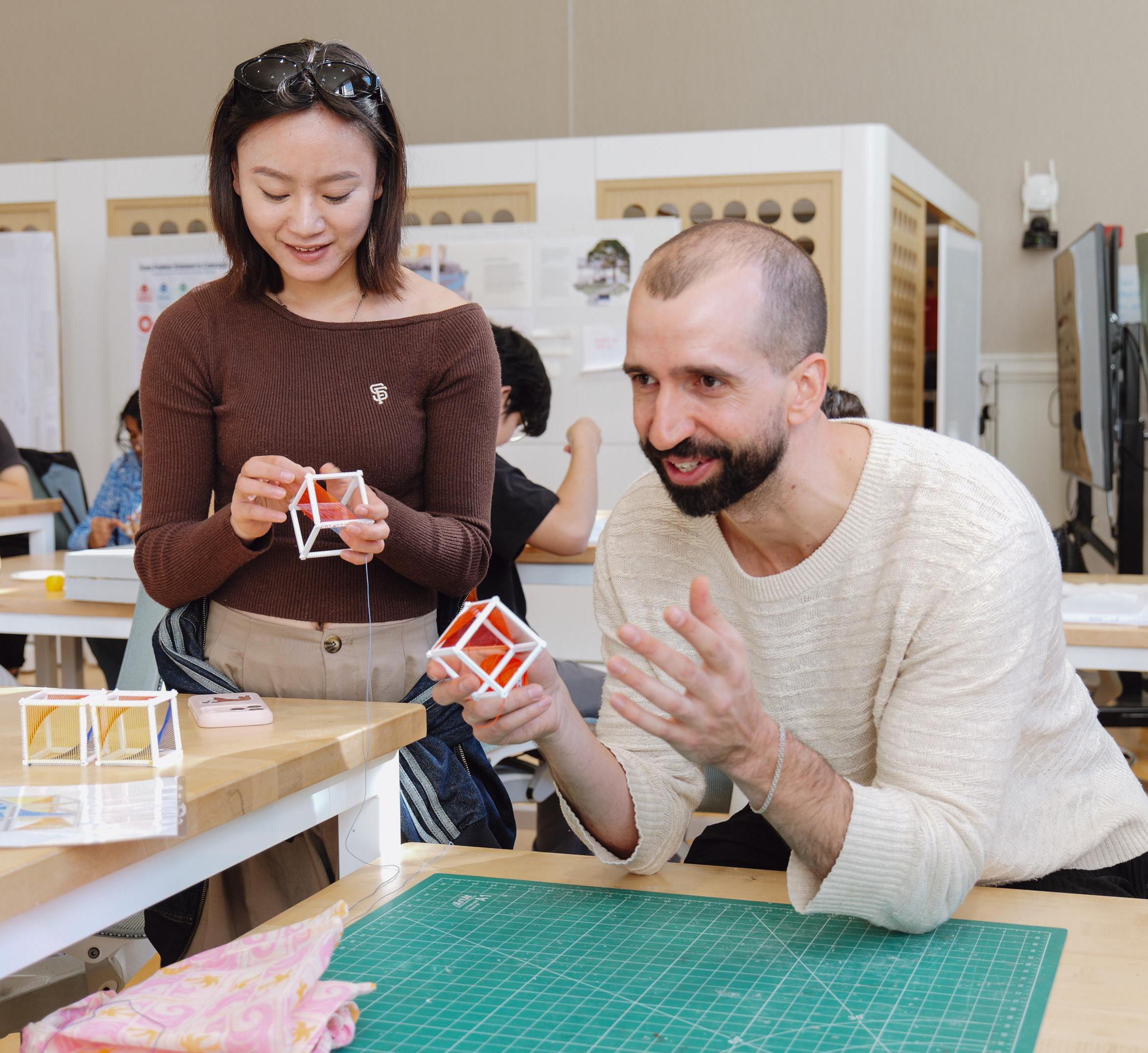
Yoojin Heo is a master’s student in Apparel Design whose research uses 3D printing for mass customization. She was inspired by Fitch’s pioneering use of the technology to embellish garments with color and sparkle.
“I’ve been following his work for so long. I think he's a genius at what he’s doing with textiles and 3D printing,” said Heo. “I was excited to actually meet him and ask him about his inspiration.”
Informal interactions build connections and community
Fitch also attended classes and worked individually with students and faculty in Cornell Human Ecology and the Department of Design Tech. The residency offered time for him to become part of the Cornell community and gain inspiration, critique and insight.
“Having a designer embedded in our community — not just the events, but in the smaller interactions — offers a tremendous opportunity for students to engage and build connections,” said Catherine Kueffer Blumenkamp, HCD assistant teaching professor and the residency host. “Bringing in artists and designers who come from elsewhere also broadens reach for all of us.”
Throughout the residency, Fitch encouraged students to pursue work they find meaningful and to maintain a connection to the physical world.
“However you do the work that you do, make sure it has a physical manifestation in something, whether it's tactile or performative, collaborative or functional,” he said. “And find things you love doing and can't stop doing. That’s important advice for life.”
The residency was supported by the Excellence in Design initiative, a gift from Lori Oscher Friedman ’91, whose own student experience was impacted by a visiting designer. Previous designers include Thijs Verhaar and Lyske Gais of the Knitwear Lab; Galina Mihaleva, wearable tech expert; and Mimi Prober, luxury-upcycler.