




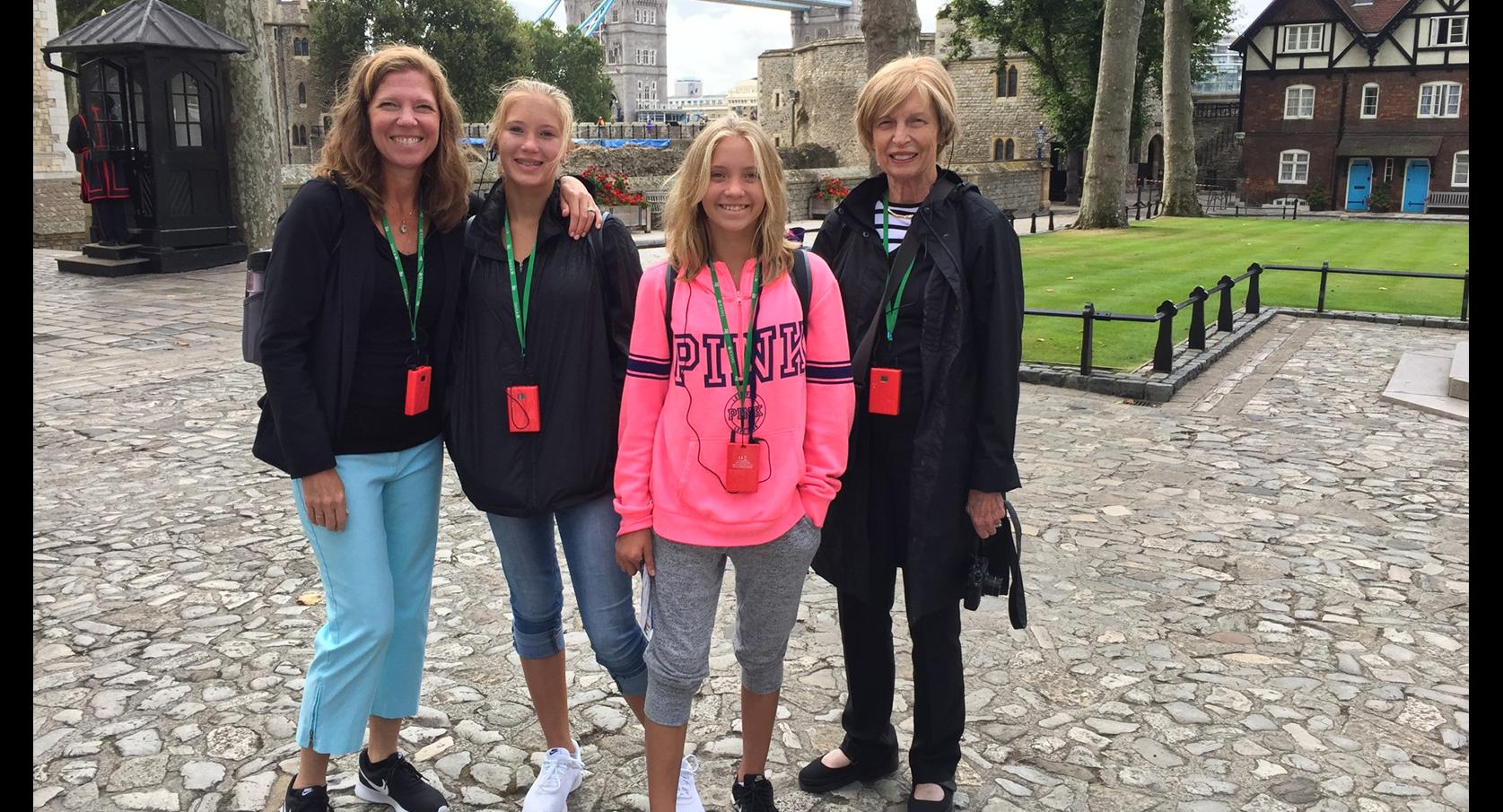
Left to right: Christine Teal ’88 with her daughters, Ashley '25 and Ellie '28, and her mother, Nancy Brown ’59.
Teal went on to medical school at the University of Pennsylvania, with funding from a military scholarship. After a surgical residency at Cornell’s teaching hospital, now known as Weill Cornell Medical Center, Teal spent four years as a surgeon at Andrews Air Force Base in Maryland, where she heard about her loved ones’ diagnoses.
In 2001, Teal moved to George Washington University to focus on breast surgery. The following year, she became chief of breast surgery and took the helm at the Breast Care Center. “It’s a calling for me,” said Teal, also an associate professor at the university. “I look forward to going to work every single day.”
Throughout her career, Teal’s approach has been informed by personal experiences. Her mother recovered from her initial bout with breast cancer thanks to medication and radiation, but 13 years later, doctors found cancer in the other breast that had spread to her lymph nodes. She was treated with a double mastectomy, chemotherapy and radiation, but the cancer recurred four years later. She died six years after her second diagnosis.
“I treat each patient as if they were my mother, my sister, my daughter,” Teal said. “I do my best to make them feel safe and let them know we’re going to do everything we can to keep their lives as normal as possible and make cancer something of the past.”
Teal was also inspired by the experience of her best friend, Laurie Holsinger Turney. Her father had died young of breast cancer, and Laurie was terrified after getting diagnosed in her thirties. Though her cancer recurred in 2006, six years after her initial diagnosis, doctors treated it aggressively, and she has remained healthy since.
“I learned about the importance of giving hope,” Teal said. “All of us should be doing that for our patients until it’s time for comfort only to be our goal .”
Laurie’s treatment model, which included alternative therapies, also showed Teal the value of a holistic approach. At GWU’s Breast Care Center, Teal opened a clinic offering complementary treatments such as naturopathy, reiki and massage. Today, the center provides physical therapy on site and is investing in mental health offerings, including a virtual mindful wellness series.
In 2011, Teal decided to have a preventative double mastectomy, based on her family history and the fact that her mother’s second aggressive cancer didn’t show up on a mammogram or ultrasound. Some colleagues were supportive, but others challenged her decision. Teal wondered, “If I’m being questioned and this is my specialty, what’s happening to other women out there?”
Last year, along with her colleague Dr. Rachel Brem, Teal published No Longer Radical, a book that aims to help those facing a diagnosis or high risk of breast cancer understand the option of mastectomies and take charge of their care plan.
“There is a big push, especially in the surgical world, to encourage breast conservation at all costs,” Teal said. “I’m all for that and it is the most appropriate choice for most women, but ultimately it’s a patient’s choice. We wanted to put the information out there for those who want to discuss the option of mastectomies.”
This August, Teal’s two daughters drove to Cornell together, while she and her husband took a separate route with their belongings. The oldest, Ashley, was entering her senior year as a nutrition major, the third generation in her family to attend the College of Human Ecology. Her younger sister, Ellie, was starting as a first-year student in the School of Industrial and Labor Relations.
En route, Teal’s daughters passed a double rainbow, then a single rainbow as they entered Ithaca.
“In our family, whenever there’s a double rainbow, we say my parents are visiting and when it is a single rainbow it is my mother,” Teal said. “It’s a dream come true that my daughters are at Cornell and that the legacy continues, and I know that my mom was there to welcome them.”