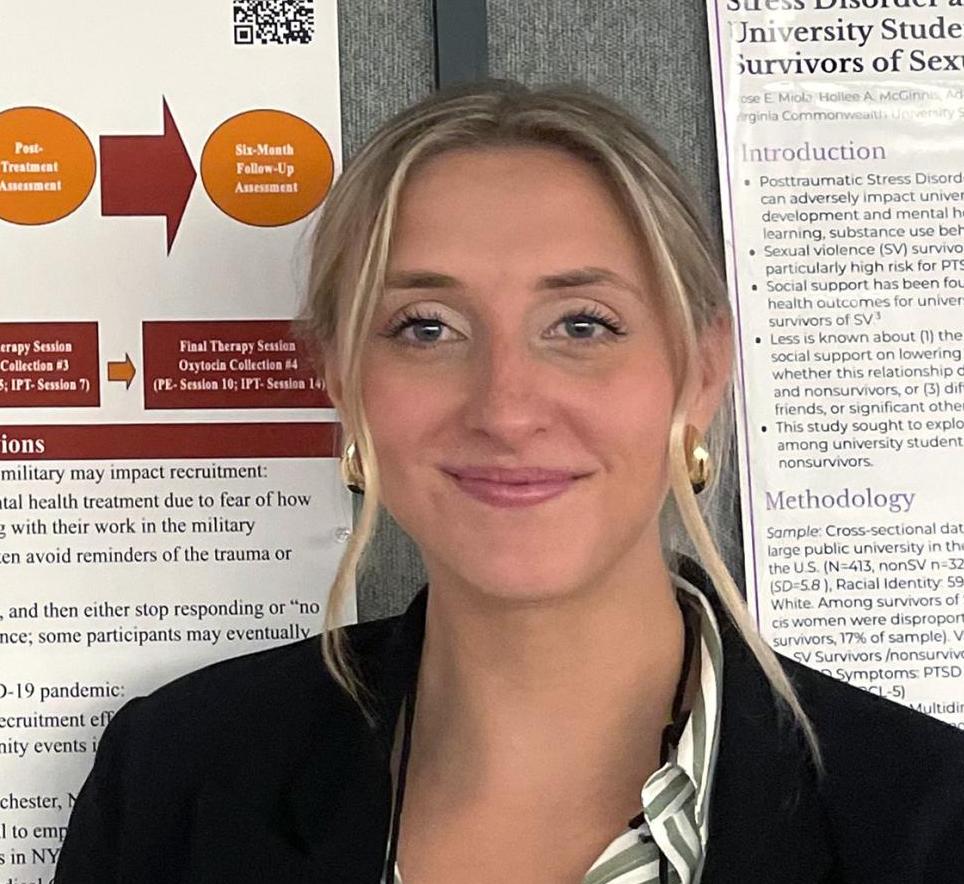
Olivia Baryluk’s favorite course in high school was AP psychology. She came to Cornell knowing that she wanted to major in human development, but she didn’t know where her degree would take her. 

As a Cornell student, she conducted research in two psychology labs and volunteered at both the Jenkins Center for Hope and Recovery and the Cayuga Medical Center behavioral health unit, as part of the Person-Centered Advocacy Team (PCAT). Those experiences, along with internships, helped shape her career path.

Today, she is a doctoral student in clinical psychology at Hofstra University, where she aims to study the factors that perpetuate mental health symptoms associated with anxiety, depression, traumatic stress, and obsessive-compulsive symptoms. She hopes to make mental health care more accessible in the future.

What does your work look like?

As a doctoral student, I’ve attended classes and seen patients in the Anxiety and Depression Clinic at Hofstra University. This fall, I will conduct psychological evaluations/cognitive assessments for patients and begin writing my master’s thesis.

What made you choose this graduate degree?

As an undergraduate, I did a summer internship at the Westchester Institute for Human Development. I was intrigued by the different forms of assessments and therapies used to help identify and treat mental health symptoms, specifically among children who experienced trauma. 

The internship taught me that a career in clinical psychology was the right fit for me. I also came to appreciate that although I love working with children, my clinical research interests have gravitated toward working with adults who have experienced trauma.

Tell me about your experience at Weill Cornell Medicine.

After graduation, I spent four years as a research coordinator for the Program for Anxiety and Traumatic Stress Studies at Weill Cornell Medicine. I coordinated a clinical trial comparing two forms of therapy for individuals with post-traumatic stress disorder.

I worked with individuals who experienced traumatic events, particularly military personnel and veterans. This experience has shaped my clinical and research interests and strengthened my desire to contribute to improving their lives.

I fielded an overwhelming number of calls from individuals who could not afford mental health treatment. I gained a better understanding of how factors such as age, gender, occupation, and income can influence mental health outcomes and access to treatment. I want to contribute to the field of clinical psychology by conducting treatment and research that takes these factors into account.
 

Posted on
11/04/2026
Author
Marisa LaFalce
Tags
Holistic Human Health, Alumni

I gained a better understanding of how factors such as age, gender, occupation, and income can influence mental health outcomes and access to treatment. I want to contribute to the field of clinical psychology by conducting treatment and research that takes these factors into account.

Olivia Baryluk ’20
Doctoral student

What is one thing you learned that you wish you knew as an undergrad?

As an undergraduate, I often felt overwhelmed by not knowing what I didn't know while also hearing that I had to do X and Y to get to Z. However, I learned that there is no single correct path to getting into graduate school or developing a career in clinical psychology. Finding the right path for you takes time.

What CHE class prepared you best for your career and why?

Developmental Psychopathology, because it introduced me to the symptoms and characteristics associated with certain disorders. We identified specific behaviors and factors that may be important to consider when understanding psychological disorders. This knowledge has been valuable for me both as a clinical research coordinator and as a Ph.D. student.

Anything to add?

Get involved in as many extracurriculars and opportunities as possible, whether it be participating in a club, doing an internship, attending a seminar, or simply reading a book/article. Given the vast number of areas and specialties you can research, each involvement can help you tailor your interests!