


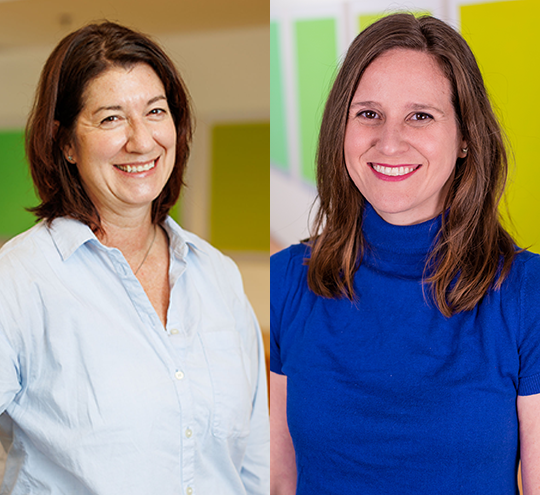
Laura Bellows, a professor in the Division of Nutritional Sciences, has been named the new faculty director of the Bronfenbrenner Center for Translational Research (BCTR). She begins her term on Sept. 1, taking over for Anthony Burrow, professor of psychology, who led the center for six years.
Bellows came to Cornell in 2021 after 20 years at Colorado State, where she earned a Ph.D. in community nutrition. Bellows’ research focuses on early childhood, specifically working with children on eating behaviors and physical activity patterns. Community engagement has been a common thread in her career.
“Getting research from campus to communities, ultimately showing the impact that our research can have on individuals and families, it’s been the foundation of my research,” Bellows said.
From her early work as a county extension agent to her roles as a faculty member and state extension specialist, Bellows has focused on building partnerships with communities and connecting research with community priorities.
“Holistically, I’ve always done translational research. My career trajectory and my scholarship have led to the BCTR,” Bellows said. “I’ve been appreciative of the BCTR because it puts resources toward [translational research] and creates a community of scholars who do community-engaged work, rather than everyone being on their own.”
Bellows is no stranger to the BCTR; she was the Evalyn Edwards Milman Faculty Fellow from 2023-2025, which supported her research on health and well-being of early childhood care and education workers. Bellows is collaborating with Kim Kopko, the director of the Parenting Project, to expand a digital program on mindful parenting that promotes healthy eating and activity for preschool children in partnership with Cornell Cooperative Extension. She has also collaborated with Cornell University Cooperative Extension - New York City.
Much of Bellows’ work has been rooted in the Head Start program, founded in part by the BCTR’s namesake, Urie Bronfenbrenner. Promoting the value of Head Start and leaning into Bronfenbrenner’s legacy will be one of Bellows’ priorities as director. She was part of the BCTR’s inaugural Head Start and Early Childhood Education Summit and is helping to shape this year’s summit on Sept. 19 in New York City.
“It’s a nice way to celebrate the legacy of our namesake and highlight how important Head Start is for children, especially at a time when it’s proposed to be gutted by this current administration,” Bellows said.
In her role, Bellows will focus on setting a strategic direction to advance the BCTR’s visibility, partnerships, research excellence and long-term growth. She will work closely with college leadership on elevating the BCTR’s profile across the university, foster engagement and collaboration, and steward fundraising efforts for the BCTR and its projects. Bellows also wants to amplify how the research from the BCTR can improve the lives of people in communities while positioning the center as the home for community-engaged research at Cornell.
“The BCTR has already been showing the public impact of its work, but we need to continue to do that in order to help build back the trust the public has in higher education,” Bellows said. “We need to continue to focus on how our work is done in a bi-directional way with community voices as a key part.”
In addition, Bellows wants to forge connections between the center’s projects that could create research that has tangible public impact. It’s a continuation of the work Anthony Burrow spearheaded as he took over the center in 2020 amid the COVID-19 pandemic. Burrow says in a time of uncertainty, he was immediately confronted with a question of how to bring the project teams working within the BCTR closer together when they couldn’t physically meet.
“Simply being together felt like a critical antidote to what was happening at the time,” Burrow says. “We felt fortunate to be meeting, even if only virtually, and reconnecting. Forging deeper connection among our projects became a thread of what we worked on for the next six years.”
While the BCTR’s focus is research with a community-engagement lens, Burrow prioritized engagement within the center, especially as the BCTR’s home base moved from offices near the airport back to campus. Burrow encouraged collaborative work between projects with adjacent or overlapping research focuses, and he viewed the BCTR as an incubator for community-engaged research projects that didn’t exactly fit into departments, like the Action Research Collaborative and Community Neuroscience Initiative.
“This center has become a place where new ideas can receive the early support and engagement needed to get off the ground,” Burrow said. “And once they’ve taken off, the people who champion them figure out ways to fit them alongside the broader community of already existing projects. It’s a unique attribute of our center.”
Burrow is proud of how the BCTR is more connected to the College of Human Ecology since the pandemic, being viewed not just as part of the college’s extension efforts, but as a contributor to the college’s teaching mission, offering students a variety of ways to study translational research, including the new Translational Research Minor.
“It’s another vital piece that connects the BCTR to the college, and it helps us become more visible across the college and across the university,” Burrow said.
Burrow’s first involvement with the BCTR was serving as director of the Program for Research on Youth Development and Engagement (PRYDE). Burrow will remain involved with the BCTR, directing the Purpose Science and Innovation Exchange, which is housed in the center.
PRYDE is now led by Kristen Elmore, who has been named the BCTR’s executive director. In her new role, Elmore will work closely with Bellows on creating a strategic vision for the center. Elmore will lead the center’s day-to-day operations and student engagement efforts.
“One key priority is to expand the BCTR’s capacity to share our knowledge of translational research practice and community partnership with students and other academics looking to have social impact through their work,” Elmore said, adding that encouraging collaboration among projects will also be a focus.
Elmore has been part of the BCTR since 2016, starting as a postdoctoral associate working with PRYDE. She became assistant director of PRYDE in 2018, taking over as director in 2025. Elmore was also named the associate director of the BCTR in 2024.
Posted on
08/21/2026
Author
Tags
Community Engagement
Share


