


As the federal government weighs the most significant changes to Head Start in nearly two decades, researchers and educators see a chance to learn what children and families in the antipoverty program need most.
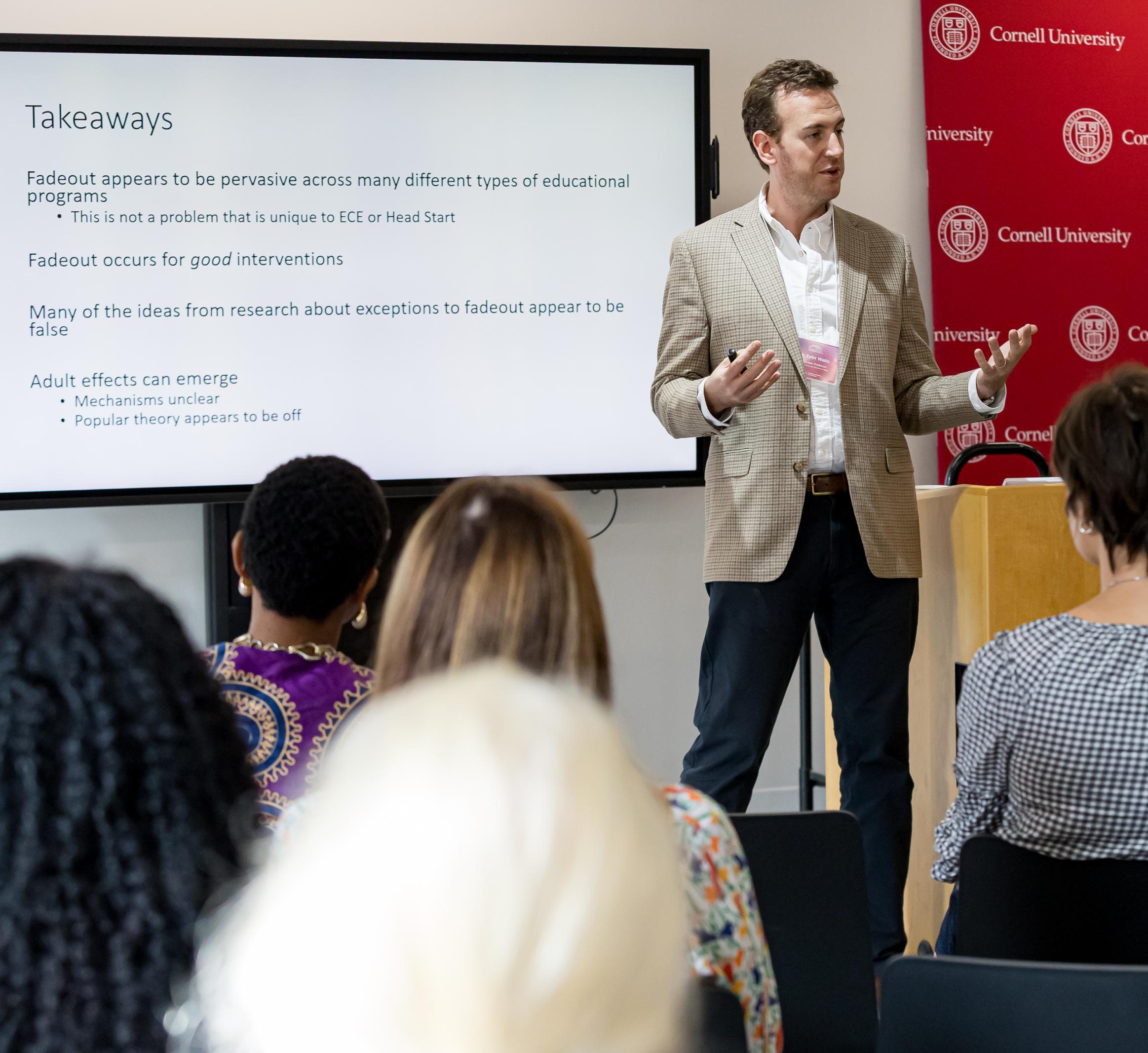
More than 80 educators, researchers and policymakers gathered at the Head Start and Early Childhood Education Summit in New York City to discuss the proposed changes and how research can inform the program’s future. The Bronfenbrenner Center for Translational Research hosted the Sept. 19 event in partnership with the New York State Council on Children and Families. Part of the College of Human Ecology, the center translates research findings into innovative interventions, practices and policies to improve human health and well-being.
“Bringing these different perspectives together sparks better questions that can identify where more research is needed,” said Laura Bellows, BCTR director. “It also cultivates partnerships that can turn what we learn into stronger programs and better outcomes for children and families.”
An effort – backed by research – to lift children out of poverty
Head Start provides educational, health, nutritional, and social services to low-income children and their families, run by the Department of Health and Human Services (HHS). Urie Bronfenbrenner, a developmental psychologist and the center’s namesake, helped found the program in 1965 as part of President Lyndon B. Johnson’s War on Poverty. It has served more than 40 million children since it began.
Research has linked the program to helping children go further in school, improving their health and reducing teen pregnancy rates, according to Chloe Gibbs, a senior economist at the W.E. Upjohn Institute for Employment Research who was part of the summit’s panel on research, practice and policy.
Proposed rule changes could reduce standards
Local agencies deliver Head Start programs, adapting the federal program to the needs of families in their service area. To ensure quality, they must meet robust performance standards that cover governance, operations, and financial and administrative requirements.
In August, HHS announced plans to eliminate hundreds of these regulations, leaving many specifics up to state and local laws. The proposed changes include lowering the administrative cost cap from 15% to 5%; removing federal requirements for curricula and class size; scaling back health and safety provisions for children; shortening the minimum classroom day to three hours; requiring families to provide proof of eligibility rather than self-attestation; ending mandatory slots for children experiencing homelessness or in foster care; and requiring instruction in English.
The department argues that the changes are necessary because spending per child in the program increased between 2015 and 2024, while the number of slots available decreased. It also says the quality of teacher-child interactions has plateaued.
Tommy Sheridan, deputy director of the National Head Start Association, delivered a policy update at the summit. Discussing the proposed changes, he said funding for Head Start hasn’t kept up with rising costs and inflation.
“Programs have seen no increase in the last three to four years,” Sheridan told attendees, noting that the costs of insurance, fuel and food are straining local programs.
Sheridan said Head Start has wide-ranging support from voters and Congress, along with HHS. He said HHS wants the program to remain effective while operating more efficiently with less regulation.
New research should look at the effect on families
Alberta Conteh, director of Bank Street Head Start in New York City, joined Gibbs and Tyler Watts (Teachers College, Columbia University) for the panel discussion. Conteh said the proposed changes will affect not only children, but also families who rely on their local program for services, support and a trusted community.
“We work with the family, not just the child in the room,” she said. “Helping them find good nutrition, making sure they have dental care, medical care, and referring them to support if needed. If you’re not fixing what’s happening at home, that just means nothing.”
Conteh added that Head Start’s work with families should be a priority area for researchers looking to understand the program’s impact.
Gibbs said having children in Head Start gives parents, particularly mothers, time to go to work or school. The proposal to reduce the minimum number of hours could have cascading effects on parents’ work and schooling, she said, identifying another potential area of research.
“These are effects that are likely to persist throughout mothers’ careers, and that has important ramifications for themselves and the well-being of their families,” Gibbs said.
A call for more comprehensive, long-term research
The last comprehensive study of Head Start’s impact was published in 2010, using data collected from 2002 to 2006. It measured the program’s effectiveness over a short period of time and didn’t follow children into adolescence or adulthood. That’s a limitation, according to Gibbs.
“We know about the long-term effects for earlier cohorts,” she said. “Does that persist for more recent cohorts? There is a big gap in what we know and it’s getting harder to measure the effect of Head Start.”
Watts noted that a study like that would take years. But if the proposed changes are adopted, he said their effects should be analyzed.
Attendees concluded the summit with group discussions on next steps. They discussed how New York State could step in to preserve some of the current Head Start standards if the changes take effect. They also mentioned the need for more research on the program’s effectiveness, how it is implemented, and the needs of its workforce. They recommended ensuring that research is easily accessible so it can be used for professional development.
“Sites are probably going to adapt to these new laws and figure out how to make it work for their site in different ways,” Watts said. “It presents a really interesting opportunity to actually look at who this is working for, how this is working in our spaces, and that we can learn from.”
Posted on
09/25/2026
Author
Tags
Community Engagement,
Holistic Human Health,
Social Impact + Justice
Share


