scientist in a lab coat holding up test tubes

About HCD and FSAD

Our department is Human Centered Design (HCD) in the College of Human Ecology.  

Our field is Fiber Science and Apparel Design (FSAD). At Cornell, graduate study is organized using a field structure. Fields are composed of faculty members from a number of departments who come together around a shared intellectual interest and may draw from different campuses or colleges. 

Our expertise is at the nexus of creative expression and scientific research resulting in real-world applications. FSAD is home to state-of-the-art apparel design studios, multiple research labs and the Cornell Fashion + Textile Collection. Students and faculty in FSAD also have access to the Digital Design and Fabrication Studio. Learn more about our spaces and studios. Our extensive alumni network provides opportunities for industry visits and career explorations through internships and career speakers.

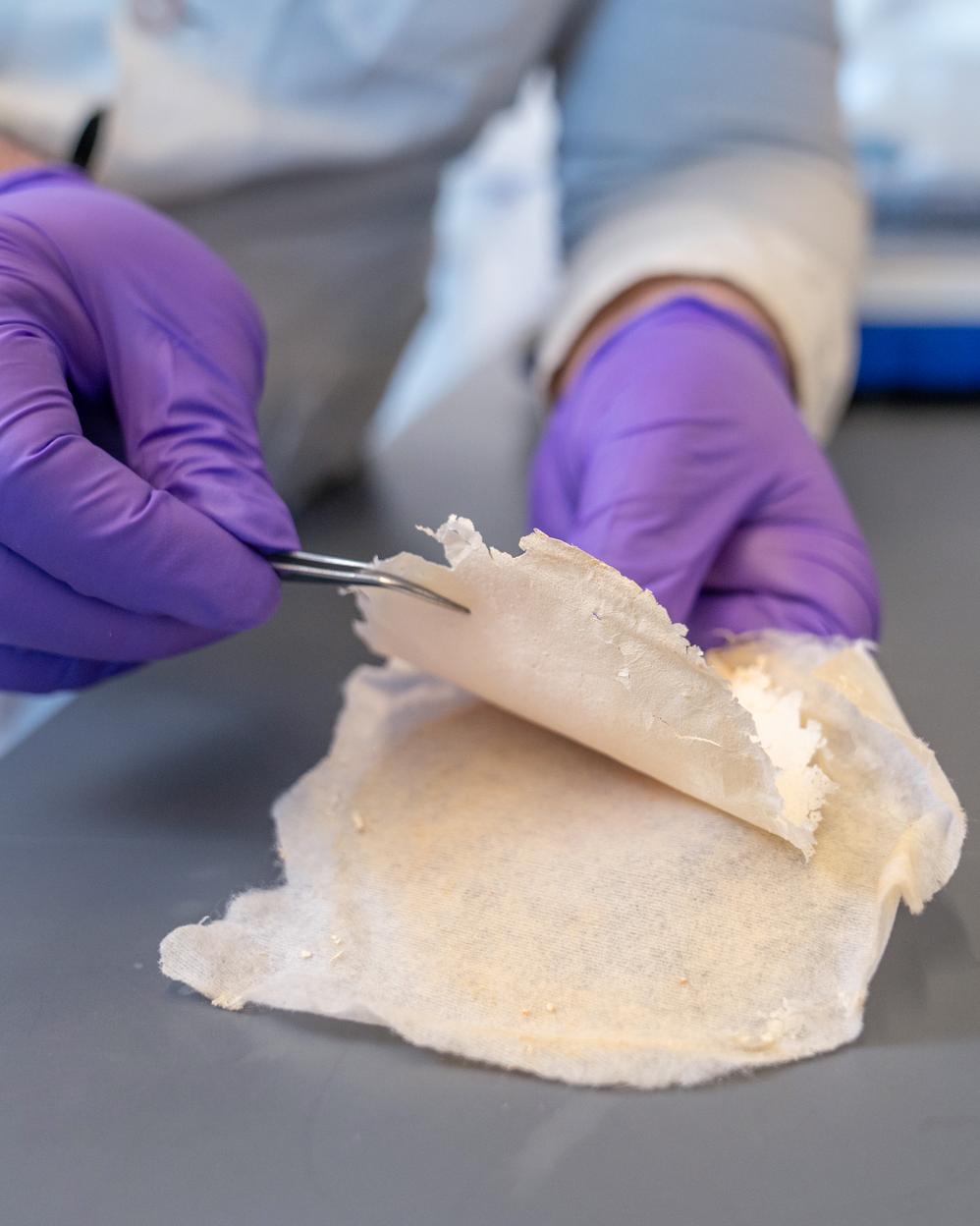
purple gloved hands usng tweezers to separate discs of fabric

Curriculum

A written thesis is required for completion of all graduate degrees in Fiber Science and Apparel Design. Candidates for the Ph.D. require at least three years of full-time study beyond the master's degree.

Fiber Science is a STEM field. Graduates may be eligible for an additional 24 months of OPT upon graduation. For more information, contact the Office of Global Learning.

Design your own track

With the help of a special committee, each student in the field plans an individualized course of study.

Core courses

  • FSAD 6160 Rheology of Solids: Dynamic Mechanical Analysis of Fibers and Polymers
  • FSAD 6200 Physical Properties of Fiber Forming Polymers and Fibers
  • FSAD 6400 Polymer and Fiber Characterization
  • FSAD 6260 Advanced Textile Chemistry
  • FSAD 6460 Nanotechnology of Fibers and Textiles
  • FSAD 6860 Mechanics of Fibrous Assemblies and their Composites
  • FSAD 6660 Fiber Formation Theory and Practice

Minors

One minor area is required of Ph.D. students. Often students select minors in the physical sciences, engineering, economics, marketing, computer science, communication or other graduate fields.

See the graduate student handbook for a complete program description

Application information

The fall admission deadline is December 15. We do not admit for spring. 

Applications for graduate study are submitted directly to the Cornell University Graduate School, which has jurisdiction over all graduate work and advanced academic degrees. A complete application includes a statement of purpose, a personal statement, unofficial transcripts, and two (preferably three) letters of recommendation. Please do not include copies of certificates, passports or other documents. We will not review your application until it is fully complete, including TOEFL/IELTS test scores if required. 

No individual faculty member can offer you admission. A graduate admissions committee will read your application when it is complete and make the decision. 

Application fee waivers are available in the application.

Admissions are based on evidence of potential capability for advanced study. 

Applicants for the Ph.D. must already hold an M.S. in textile chemistry, textile science, polymer science, engineering, chemistry, physics, applied mathematics or a similar discipline. Applicants must have completed courses in calculus, physics and organic chemistry. Applicants may be required to make up any deficiencies before admission or as part of the requirements for the degree.

We do not require the Graduate Record Exam (GRE).

International applicants must demonstrate proficiency in the English language by taking a TOEFL (Test of English as a Foreign Language) or IELTS (International English Language Testing System) exam. 

Minimum TOEFL scores are: 

  • Writing: 20
  • Listening: 15
  • Reading: 20
  • Speaking: 26
  • Minimum total score: 100

If all of these scores and the total are not met, applications will not be reviewed. 

The Graduate School requires an overall band score of a 7.0 or higher on the IELTS.  

For more information, including waiver information, see the graduate school’s website.

Cornell University expects all applicants to complete their application materials without the use of paid agents, credentials services or other paid professional assistance. The use of such services violates university policy and may lead to the rejection of application materials, the revocation of an admissions offer, cancellation of admission or involuntary withdrawal from the university.

Financial support, in the form of teaching assistantships, graduate research assistantships or fellowships, is offered with acceptance to Ph.D. students only. Full assistantships include tuition, fees and individual health insurance. Assistantships are offered for four years. Continued funding is contingent upon acceptable academic performance constituting good standing in your graduate field and satisfactory fulfillment of any teaching or research responsibilities as defined by your assistantship supervisor.

Faculty research

In addition to the faculty from HCD, the Graduate Field of Fiber Science and Design includes faculty from chemical engineering, chemistry, civil engineering, materials science and engineering and theoretical and applied mechanics.

Current faculty research areas include:

  • surface modification of high-performance fibers for composites
  • novel techniques for fiber and polymer morphology studies
  • protective clothing for agricultural, industrial and medical workers
  • electrostatic technique for fiber spinning
  • fully degradable "green" composites
  • reinforcement of cement concrete by fibers
  • synthesis of biologically active biodegradable fibers
  • role of free radicals in degradation of biodegradable fibers
  • novel chemical synthesis of degradable polymers
  • fibers for tissue engineering and regeneration
Learn more
scientist in a lab coat pointing at fiber samples
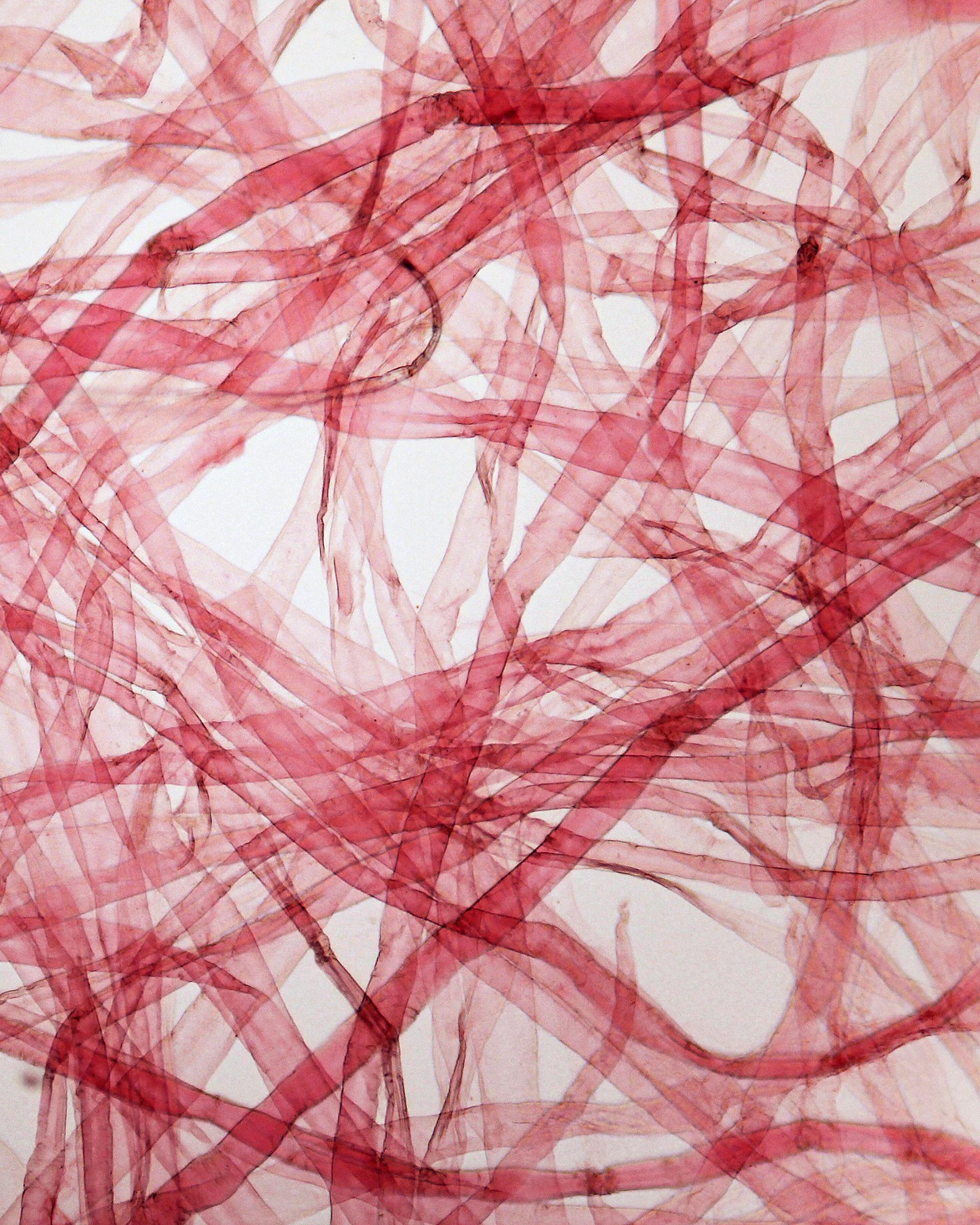
microscopic view of red fibers

Faculty you'll work with

smiling man sitting in a blue chair
Rebecca Q Morgan '60 Professor of Fiber Science & Apparel Design
Focus areas Intersection Science-Design, Nanomaterials in Textiles, Use of waste as raw-material
portrait of a woman wearing glasses and standing in front of bright green panels
Assistant Professor
Focus areas Tailoring fibers (spinning) for practical applications, Optically responsive fabrics, Immersion electrospinning
man wearing glasses sitting in a bright blue chair
Associate Professor
Focus areas Nanofibers and nanotextiles, Medical textiles and drug delivery, Water treatment, food packaging